In June 2024, two teenagers from Kharkiv region travelled to Odesa region for a holiday. One day, the older of the two got into an argument with strangers. While drunk, he stabbed and wounded one of them and killed another. The boys fled to Odesa, but police later found them at a hotel. This might have been simply a murder case. But it turned out that the boys’ trip to southern Ukraine had been paid for with money from Russia. They had been paid to set fire to military recruitment centres in Kharkiv.
A Slidstvo.Info journalist analysed the court records and spoke to the head of the Kharkiv Regional Prosecutor’s Office to reconstruct how the boys were recruited, trace their preparations for the acts of sabotage and explain how the story ended.
After the arson attacks — off to the seaside
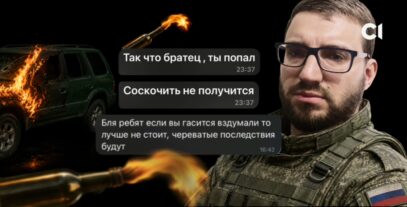
In spring 2024, a 17-year-old from the Kharkiv region was contacted on Telegram by a representative of the Russian security services. The recruiter had come across the teenager in a job-search group and offered to pay him to set fire to police stations, military recruitment centres and other buildings. The teenager was interested and shared the idea with a 16-year-old acquaintance, suggesting that they carry out the arson attacks together. His friend agreed. He has six brothers and lives in cramped conditions and poverty.
The Kharkiv Regional Prosecutor’s Office says the teenagers chose the buildings themselves, based on which ones would be easiest to set alight without being caught on CCTV.
The two accomplices also ‘practised’. The older teenager drained fuel from his moped, and the boys used instructions they found online to make a Molotov cocktail. They then rode the same moped to an abandoned building.
‘They practised throwing the Molotov cocktail at the wall of the building to see how the homemade incendiary mixture burned — and whether it would burn at all,’ said Yurii Papusha, head of the Kharkiv Regional Prosecutor’s Office.

The teenagers then took a bus to Kharkiv.
They set fire to the first building on the night of 26 May. It was the Industrialnyi District military recruitment centre. At 9 p.m., the younger teenager arrived at the older boy’s home. From there, they headed to the recruitment centre, taking with them a bottle, flammable liquid and a piece of cloth they had prepared in advance. At around 11.20 p.m., one of them soaked the cloth in the liquid, placed it in the glass bottle, set it alight and threw the bottle at the building. The bottle smashed and the entrance doors caught fire.
The younger teenager filmed the attack on his mobile phone. The boys also left a note outside the recruitment centre with a crossed-out triangle and the name of a Telegram channel.

After the arson attack, they fled and sent the video to their handler as proof that they had completed the task. He transferred UAH 36,920 to their bank card. Investigators later established that the Russian security services used the footage for propaganda purposes.
After the arson attack, they fled and sent the video to their handler as proof that they had completed the task. He transferred UAH 36,920 to their bank card. Investigators later established that the Russian security services used the footage for propaganda purposes.
The boys set fire to the Kyivskyi District military recruitment centre on the evening of 4 June 2024. They prepared for the attack in the same way and, at around 9.30 p.m., after making sure no one was watching them, the older teenager threw the [bottle] at a window of the recruitment centre. The window frame caught fire.
The younger teenager again filmed the attack for their handler. For the second arson attack, the handler made two payments: UAH 10,000 and UAH 31,359.
According to the Kharkiv Regional Prosecutor’s Office, a few weeks after receiving the money for the acts of sabotage, the teenagers travelled to Odesa region for a holiday, where they spent their ‘reward’.
It was there that the conflict took place during which, according to prosecutors, the older teenager, who was intoxicated at the time, stabbed one stranger and killed another. The teenagers fled to Odesa, where they were arrested by police. Meanwhile, the acts of sabotage were being investigated in Kharkiv.
‘We can make some cash’
In June 2025, the older teenager was sentenced for intentional homicide and minor bodily harm. He received seven years and six months in prison for the killing and one year of probation supervision for the minor bodily harm offence. His final combined sentence was eight years’ imprisonment. At the same time, according to Yurii Papusha, the boys were also under investigation in the Kharkiv region over the arson attacks on military recruitment centres. The verdict in that case was delivered on 12 June 2026.
Both of those convicted were students at vocational education institutions in the Kharkiv region. The younger teenager was studying cookery at a vocational college and had no previous convictions. Papusha says his large family was indeed experiencing financial hardship and that, as the teenager explained during the pre-trial investigation, this was what prompted him to look for ways to make easy money. He told the court that he intended to turn his life around.
‘The younger teenager fully admitted his guilt and expressed genuine remorse for what he had done,’ Papusha says. ‘The older one, however, refused to give any evidence. In court, he merely said that it was all untrue and defamatory, and that the money he had came from working at a car repair garage.’
The older teenager declined to give evidence in court and denied committing the offence, asking to be acquitted. He argued that photographs and videos from the Telegram channel did not prove his involvement. His Telegram contacts included the handler’s phone number, but the teenager told the court that he did not remember who the person was.
The younger teenager, by contrast, said that in spring 2024 his acquaintance had been communicating with an unknown individual who offered them $2,000 to set fire to military recruitment centres. The teenager described how they searched for suitable buildings, practised and then carried out the arson attacks. According to him, after the second attack, their handler said they had not completed the task in full because they had failed to provide information about the aftermath or whether the fire had affected the recruitment centre’s operations.
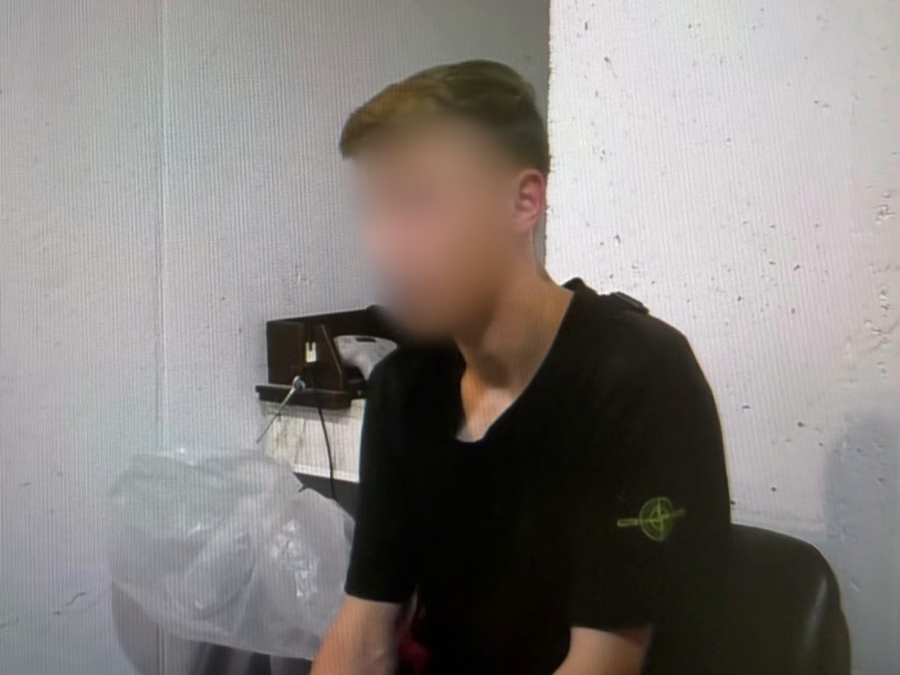
His bank card received separate payments of UAH 2,000, 5,000, 15,000 and 18,000.
Shortly after the second arson attack, the boy travelled to Odesa region with his accomplice and a female friend to visit relatives. They received no further offers of work from their handler.
A female friend of the younger teenager also testified in court. They had met on Telegram in February 2024, initially playing an online game together before later meeting in person. The boy told her that he was studying cookery, came from a large family and had a friend — the same teenager who had agreed to carry out work for the unidentified individual.
She said that during one of their outings in May 2024, the boy received a phone call from this friend. He told him that he had been offered money to carry out arson attacks and asked him to join in.
The girl also told the court that in early summer 2024 they travelled together to Odesa to visit the older teenager’s mother. The boys paid for the trip. Police later arrived at the place where they were staying and said that the boy was suspected of arson. The girl returned to Kharkiv and stopped communicating with him.
In court, however, the older teenager denied the girl’s account that he had called the younger boy and invited him to take part in the arson attacks. He claimed that they had been friends for a long time and that he had lent the younger teenager money which had never been repaid. According to him, this was why the younger boy had decided to falsely implicate him. The evidence in the case, however, included Viber messages exchanged between the two teenagers.
Their messages from May had been deleted, but a voice message dated 2 June 2024 remained. The judgment does not specify which of the teenagers sent it: ‘I’ve got the petrol, so do we take it straight away, or are we going to scout the place now? If we find somewhere, we’ll go to Rohan [an area of Kharkiv — ed.], get the petrol, walk there, get the job done and go home.’
The following day, he sent another voice message: ‘Listen, how the fuck are we going to do all this if we haven’t got all of it — no petrol, nothing?’ The other teenager replied with a voice message of his own: ‘Right, look, we need to go there now, see what it’s like and take some photos. If everything looks good, we get some petrol, fucking do it, and we can make some cash.’
The verdict
The judgment states the following about the younger teenager: ‘The issues that intervention measures should address include difficulties controlling his behaviour, a poor relationship with one parent, a negative attitude towards education, poor academic performance, frequent absences, having some friends and acquaintances who display antisocial behaviour, having no friends who display socially acceptable behaviour, both regular and occasional alcohol use, deficits in cognitive skills, verbal aggression, denial of the seriousness of his behaviour, and a lack of remorse.’
The assessment of the older teenager states that intervention should address ‘difficulties controlling his behaviour, poor academic performance, frequent absences, having some friends and acquaintances who display antisocial behaviour, occasional alcohol use, deficits in cognitive skills, impulsivity, physical and verbal aggression, denial of the seriousness of his behaviour, and the belief that it is acceptable to commit offences against certain individuals or groups.’
According to the forensic psychiatric assessment, at the time of the arson attacks he was not suffering from a chronic mental disorder. He did, however, display clinical signs of an unsocialised conduct disorder, meaning that he disregarded generally accepted social norms. The disorder was not severe enough to prevent him from understanding or controlling his actions. The same was true at the time of sentencing: he continued to display clinical signs of the disorder but remained able to understand and control his actions.
You can sign up to make a monthly donation via Monobaza!
Both teenagers were found guilty of acts of sabotage committed under martial law and as part of a prior conspiracy. Taking into account the older teenager’s previous conviction for intentional homicide and intentional minor bodily harm, the court sentenced him to 10 years in prison. The younger teenager was sentenced to three years in prison.
The court also ordered the confiscation of both defendants’ property. However, prosecutors are currently appealing this part of the judgment, as Ukrainian law does not permit the confiscation of property belonging to minors.
The use of minors to commit such offences is one of the tools of hybrid warfare actively employed by Russian security services. The footage the boys sent to their handler was subsequently used by Russian propaganda channels.
‘Russian security services used videos like these to create the impression that there was widespread resistance within Ukraine. It is all designed to create a false impression among their own population, international partners and the wider international community that such sentiments exist in Ukraine. But we clearly understand that this is all propaganda by the aggressor state,’ Yurii Papusha said.
Papusha says Ukrainian teenagers are instead treated as ‘disposable’: ‘The lives and futures of Ukrainian teenagers are of no value whatsoever to the Russian security services.’