Artem Shmul, an officer with Russian military intelligence, has been named as a suspect in absentia by the Security Service of Ukraine (SBU) for recruiting Ukrainian children to carry out acts of sabotage and terrorist attacks in Odesa. They agreed to work with him in exchange for money. The youngest was 13, while the oldest was 18. A Slidstvo.Info journalist obtained messages exchanged between the minors and their Russian handler and uncovered further details of the case.
Arson attacks
On 14 April 2024, police received a report that an unidentified person had set fire to a Ukrainian National Guard vehicle on Mechnikova Street in Odesa. A leaflet bearing the name of a Telegram channel was found nearby. The channel was used to recruit people to carry out acts of sabotage, terrorist attacks and even the killings of military personnel. In April 2025, Slidstvo.Info published an investigation into the channel, after which Ukraine’s cyber police obtained a court order to block it.
According to sources in the National Guard, the arsonist appeared to be following precise instructions: CCTV footage captured only the shadow of a person throwing an incendiary mixture at the vehicle. A few weeks after the first incident, in May 2024, police carried out a search and seized mobile phones. It remains unclear who the phones belonged to.
The investigation was then taken over by the local office of the Security Service of Ukraine (SBU). Its officers detained the boys in late May following a series of further arson attacks, and they were remanded in custody.
According to investigators, three boys — one of whom was 13 at the time — began communicating with unidentified members of the Russian security services in May 2024. They offered to pay the boys to set fire to military vehicles and railway relay cabinets. To receive payment, one of the teenagers sent them his mother’s bank card details.
During the subsequent court proceedings, it turned out that the group consisted of four teenagers. Together, they set fire to a Ukrainian Railways relay cabinet and two vehicles. As the case against one of the teenagers was already being heard when the indictment against two others reached the court, the prosecutor asked for the proceedings to be joined so that they could be tried together.
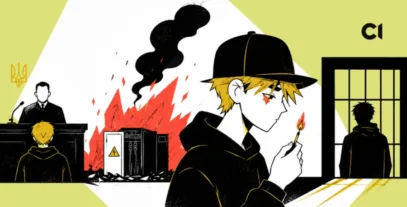
Russian security services drew up the plan and provided instructions, according to investigators. On 15 May, the three boys took some petrol and travelled to coordinates sent by their handler in Odesa’s Peresyp district. There, in a secluded location, they found a Ukrainian Railways relay cabinet used to ensure the safe operation of train services. One of the boys doused the cabinet with petrol, another set it alight with matches, while the youngest filmed everything on his phone as proof for their Russian handlers. However, the teenagers were unable to open the relay cabinet to allow the fire to spread inside, and a Ukrainian Railways employee on duty spotted the blaze and put it out.

Screenshots of a Telegram chat:
— Look, I have information about 3 [relay] cabinets
— If you’re interested
— Are you greeting for the second time?)
— Look, I’ll give you a place
— You’ll have to scout, find transformers in the area
— Photo/video
— Escape routes etc.
Two days later, on the night of 18 May, the boys set fire to a Hyundai Terracan on Dalnia Street. On 23 May, they went to scout the locations of military units. On one street, they spotted a Fiat Fiorino bearing a sign reading ‘TCC Service’ (TCC is a Ukrainian abbreviation for the military recruitment office — transl.) and a Ford Transit. The boys returned the following day. One of them brought a plastic petrol container, rags, sheets of paper and a red marker, while another brought petrol. The youngest boy joined them as well. In a park near one of the vehicles they had identified, they made Molotov cocktails using glass bottles.
As part of the planned arson attack, the boys wrote ‘TCC, BURN’ on a sheet of paper, which they were supposed to hold up in shot while filming the vehicle being set alight. The video was then supposed to be posted on a Telegram channel where Russians recruit people to carry out acts of sabotage and terrorist attacks. The boys waited until the street was deserted and, at around 2 a.m., approached the vehicles and prepared to throw the Molotov cocktails. It was at that point that SBU officers detained them.
‘Pull yourselves together and do everything properly’
On 25 May 2024, the boys were formally notified that they were suspected of attempted sabotage committed by a group acting by prior agreement (Article 28(2), Article 15(2) and Article 113(2) of the Criminal Code of Ukraine), as well as an attempted terrorist attack (Article 15(2) and Article 258(2) of the Criminal Code of Ukraine). The charges against one of the boys were later amended to include incitement to commit a criminal offence, under Article 25(4) of the Criminal Code.
On 27 May that year, a court remanded two of the defendants in custody without the option of bail. The youngest boy had not reached the age of criminal responsibility and will therefore not stand trial at present, although it remains unclear what measures will be taken in his case.
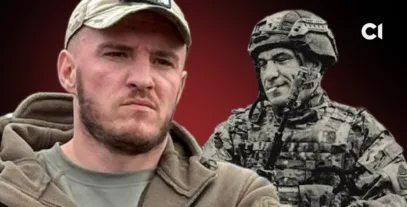
Investigators established that the boys had been recruited by Artem Shmul, an officer with Russia’s military intelligence service, the GRU.

Artem Shmul
He came across the teenagers while they were looking for ways to make easy money and posting adverts in Telegram channels. Shmul offered to pay them to set fire to vehicles belonging to Ukraine’s Defence Forces and Ukrainian Railways infrastructure in Odesa. He communicated with the boys in Russian.
According to investigators, Shmul sent the boys detailed instructions on how to destroy vehicles and railway relay cabinets. They were required to film everything on their phones and send him the footage.

The first tasks were relatively simple: Shmul asked the teenagers to spray graffiti around the city, referring to 2 May and bearing the name of the Telegram channel used for recruitment. On 2 May 2014, Odesa saw violent clashes between pro-Ukrainian and pro-Russian activists. Russian propaganda has extensively used these events as a key narrative for fuelling hostility towards Ukrainians.

On the screenshot:
— Decide yourself
— Got it
— Make a graffiti with the name of the group and ‘Odessa remembers 02.05.2014’
— Decide on the quantity yourself. The more — the better
The boys were then tasked with setting fire to vehicles and railway relay cabinets.
A Slidstvo.Info journalist obtained messages exchanged between Artem Shmul and the detained teenagers. At first, their exchanges were relatively casual, with Shmul encouraging and reassuring the boys.
He wrote: ‘That car’s been sitting there for fuck knows how long. The pre-trial detention centre was shut down, and they just hid the car there. No one’s guarding it — we checked through our own channels. The main thing is, don’t be scared and don’t panic. Pull yourselves together and do everything properly.’
But when the boys were given a task to leave something at a ‘dead drop’, they stopped responding, which angered Shmul: ‘Fuck, guys, if you’ve decided to go to ground, you’d better not. There’ll be consequences. There’s no way you can be out of contact all day.’
He then began threatening them.

‘Fuck, guys, you’re starting to play with fire. We’ve got the card number, so we’ll find out who owns it, and then we’ll send some heavies round. We’ll grab one of you by the balls first, then we’ll come for the rest.’
Shmul then began threatening the boys, saying he would turn them in to the SBU. He put pressure on the teenagers by claiming that he had all the information about their parents, which he said he had obtained using the bank card number belonging to one boy’s mother that the teenager had sent him to receive payment.
Shmul continued to pressure them: ‘So, mate, you’re in it now. There’s no backing out. You thought you could go quiet and disappear, but no — that’s not going to happen.’
The SBU believes that the purpose of the acts of sabotage Shmul recruited the boys to carry out was to provide Russian propaganda outlets with material intended to create the impression that a pro-Russian underground movement existed in Odesa.
On 11 June 2026, Artem Shmul was formally notified in absentia that he was suspected of financing terrorism (Article 258-2(2) of the Criminal Code of Ukraine) and organising a terrorist attack as part of a prior conspiracy (Article 27(3) and Article 258(2) of the Criminal Code of Ukraine).
Court proceedings
In November 2024, an indictment in the case against the teenagers accused of carrying out tasks for Shmul was submitted to Odesa’s Peresyp District Court. The case is being heard by a panel of judges.
Six months later, in May 2025, a lawyer representing one of the teenagers asked the Peresyp District Court to replace his pre-trial detention with house arrest or allow him to be released on bail. The lawyer argued that his client, who has a chronic medical condition, had sought medical assistance six times while being held in pre-trial detention, with each subsequent flare-up becoming more severe. The boy was also said to be in a poor psychological and emotional state: he had self-harmed while in detention, yet, according to his lawyer, had not been visited by either a psychologist or a psychiatrist.
At the same time, the court found that the prosecutor had failed to provide compelling evidence that the teenagers posed a risk of reoffending or destroying evidence relevant to the case. In May 2025, the defendants were therefore granted bail, set at 242,240 hryvnias. Two of the teenagers were released from custody on 9 and 12 May 2025 after the bail amount was paid on their behalf.
You can also sign up to make a monthly donation via Monobaza!
In late 2025, the prosecutor asked the court to hold the proceedings behind closed doors, meaning that journalists and members of the public would not be allowed to attend, and to withhold its rulings from public access. The judges granted the request.
Slidstvo.Info sought to find out what stage the proceedings had reached and what sentence the prosecutor was seeking for the defendants. However, the Peresyp District Court did not respond to the request for information.
The Odesa Regional Prosecutor’s Office said that hearings were proceeding according to schedule and that written evidence was currently being submitted to the court. It added that the prosecution would state its position on the type and length of sentence during closing arguments at a closed hearing. Character references for the defendants have not yet been added to the case file.
How juvenile prevention officers work with children in such cases
Until the court delivers a verdict, juvenile prevention officers cannot begin rehabilitation work with the accused teenagers. They can only place them on a preventive supervision register once the police receive the court’s decision. If the boys turn 18 while the case is still being heard, they will no longer be eligible for support from juvenile prevention services, including work with psychologists and social services.
Viktoriia Chalova, head of the Juvenile Prevention Department of the National Police in Odesa region, says preventive work by police has helped reduce the number of similar offences in the region compared with 2023–2024, when such cases first began to be recorded. According to the Odesa Regional Prosecutor’s Office, for example, one minor committed an offence against the foundations of national security in 2026.
Chalova adds that children are becoming more aware of the issue and are reporting such cases, including during talks held at schools. However, she says no separate records are kept of the number of such reports.
Police involve psychologists, civil society organisations, resource centres, children’s services, extracurricular education providers, as well as parents or other legal guardians in their work with children. They hold preventive discussions with them, involve them in civic and patriotic initiatives and sporting activities, and seek to help them socialise and engage with their communities as much as possible.
Juvenile prevention officers also teach children about online safety — for example, how to adjust privacy settings on social media so that only people in their contacts can message them.
Chalova explains that it would be wrong to assume that only children already known to the authorities or receiving support from social services are susceptible to Russian recruiters.
‘These are children from all sorts of backgrounds, of different ages and from different families. Some come from well-off families, others from families with little money. We cannot say categorically that only children from disadvantaged backgrounds are susceptible to this kind of influence,’ Chalova says.
Recruiters also use a range of different methods and approaches. They initially targeted Telegram channels where teenagers looked for part-time work, but now also use Instagram, TikTok, online games and other platforms. At first, teenagers are given simple tasks, such as spraying graffiti or putting up leaflets. These tasks do not appear dangerous, and children may not understand what they are becoming involved in.
As they communicate with recruiters, Chalova says, children disclose personal information, including where they go to school. Recruiters deliberately gather as much information about them as possible.
Recruiters move on to more serious tasks later. At this stage, Chalova explains, children often try to back out once they realise what they are being drawn into. But, she says, their handlers then resort to blackmail and intimidation: ‘They start using blackmail, looking for personal information about the child and their family, and threatening them through their parents, friends and acquaintances. The child is left feeling that there is simply no way out. But all the children detained by the police or the SBU admit what they have done and say that, if someone had explained all this to them earlier, they would never have done it.’
Russian security services use different forms of blackmail, adapting their approach to each individual case. According to Chalova, Russian recruiters systematically use psychological manipulation, particularly with younger children. They may, for example, threaten to send their messages to law enforcement, tell their parents or inform their school. At the same time, they tell teenagers that if they take a more serious step and commit a criminal offence, the recruiters will ‘protect’ them and that, because they are minors, they will face no consequences.
Chalova stresses that children who commit such offences generally have a small circle of friends and like-minded peers. ‘That’s why we need to show a child that there are many people who can support them,’ she concludes.