Two 16-year-old secondary school students from Odesa were looking for part-time work on Telegram, hoping to make some ‘quick money’. It started with anti-government graffiti, followed by arson attacks on Ukrainian Railways relay cabinets, and eventually escalated to preparing an explosive device for a terrorist attack near a military recruitment centre. Their Russian handlers gradually drew the teenagers into increasingly serious crimes, until the boys were detained while assembling an improvised explosive device.
One of them agreed to speak to a Slidstvo.Info journalist and explained why they agreed to carry out the arson attacks but ultimately refused to go through with the terrorist attack.
The case is detailed in an investigation by Slidstvo.Info.
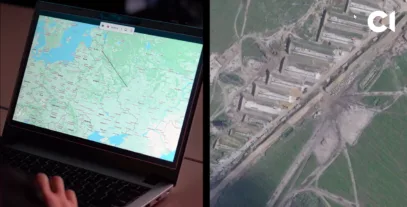
On the afternoon of 20 March 2025, two 16-year-old secondary school pupils — Maksym and Serhii (their names have been changed for ethical reasons — ed.) — arrived at a railway station near Zastava-2, in an industrial area of Odesa. They approached a relay cabinet, a piece of Ukrainian Railways equipment used to ensure the safe operation of train services.

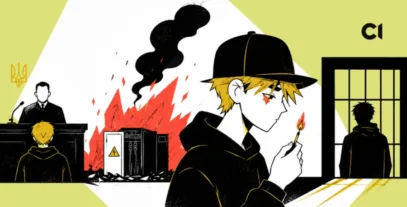
Maksym took out a plastic bottle, doused the relay cabinet with petrol and set it alight with a lighter. Meanwhile, Serhii kept watch to make sure there were no witnesses nearby and filmed the arson on his phone. The video was intended as proof that they had completed the task for their handler, who used the codename ‘Penguin’.
Serhii sent the video to ‘Penguin’, who transferred more than 5,000 hryvnias to his bank card. However, the relay cabinet did not burn down completely — the fire went out.

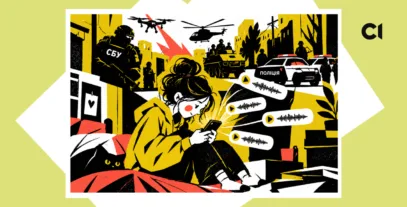
On the screenshots: instructions provided by the handler to the boys on how to choose time and places for relay cabinet arsons, shoot video and send it back to him.
A few days later, on the evening of 23 March, they travelled to Shyriaivskyi Lane in Odesa. There, they reached a railway signalling post and chose another relay cabinet. This time, Serhii set it alight while Maksym filmed everything on his phone and kept watch. They again sent a video of the sabotage to ‘Penguin’ and were paid more than 6,000 hryvnias. But once again, the equipment did not burn down completely.

According to the Security Service of Ukraine (SBU), the students also made an improvised explosive device intended for a terrorist attack near the administrative building of a local military recruitment centre.
Law enforcement officers detained the teenagers while they were preparing the explosive device, preventing an explosion near a military facility.
A Slidstvo.Info journalist spoke to one of them, Maksym. His friend declined to be interviewed.
From anti-government graffiti to sabotage
According to Maksym, they initially carried out simple tasks: spraying anti-government graffiti in exchange for money sent by their handler. Later, they agreed to set fire to railway relay cabinets. At first, Maksym was reluctant to talk. His voice sounded uncertain.
Asked why they had agreed to carry out acts of sabotage and prepare for a terrorist attack, and whether they had thought about the consequences, Maksym said he had not considered them at the time. Money was their main motivation. At first, he did not want to say what they needed the money for. He later admitted that he wanted to help his parents and friends.
According to Maksym, the Russians contacted his friend through Telegram groups advertising jobs. The students had been looking for part-time work there because employers were reluctant to hire minors for regular jobs.
‘And things weren’t great for my family,’ the teenager says.
The journalist asked whether the boys had tried taking regular jobs. Maksym said he had been cheated out of his wages six times. He spent weeks applying protective glass to phone screens but was never paid.
Maksym readily admits that, at the time, all he was thinking about was making money quickly.
‘We knew they might blow us up’
After the two arson attacks, their handler gave them a new task: to buy bleach. Then they were told to buy other household chemicals. At some point, Maksym realised that all these ingredients were intended to make an explosive device.
‘By then, there had already been a spate of incidents. We’d seen the videos and knew they might blow us up along with the device,’ Maksym says.
According to Maksym, they had no intention of completing preparations for the terrorist attack and refused to carry out the task to the end. Asked whether they were primarily afraid for their own safety, Maksym shook his head.
‘We were more worried about the people around us. There were already videos online, and we understood the blast radius. We made a mistake, but other people shouldn’t have to pay for it,’ he explained.
Maksym says he regrets what he did. He says he had wanted to help his parents, but ultimately only made things worse.
‘They [children — ed.] don’t realise that they’ll only make things worse. In moments like that, you don’t think about anything else. You only think about the money. But then your parents will end up paying even more because of you, and there’ll be all sorts of other problems. Why make things harder for them?’ Maksym says.
Slidstvo.Info on WhatsApp
Investigations, exposés and reporting from the front line
Follow us!
The court’s decision
In court, both students pleaded guilty to all charges. A panel of judges found them guilty of an attempted arson attack intended to undermine the state and damage facilities of significant importance to national defence, committed by a group acting by prior agreement.
Maksym had no previous convictions and this was his first offence. He is a student at a lyceum (secondary school — transl.), where he is regarded positively. He lives with his parents in a two-bedroom flat. His family has no financial difficulties or criminal history. He has good relationships with his parents and friends.
While being held on remand, Maksym also received positive reports: he complied with the rules, took part in sports and educational activities, studied through online learning platforms and demonstrated a sense of responsibility.
You can also sign up to make a monthly donation via Monobaza!
Serhii also had no previous convictions and this was his first offence. At the lyceum, he was described as a somewhat irresponsible student who showed little interest in his studies. He lives with his mother; his father has died. The family has no financial difficulties.
While being held on remand, Serhii received mixed reports: he breached detention rules and faced disciplinary action. At the same time, according to the case materials, he was friendly, did not get into conflicts and tended to underestimate the consequences of his actions.
The court considered several mitigating factors: genuine remorse, full admission of guilt, active co-operation with the investigation, the fact that both defendants were minors, and their voluntary compensation for the damage caused.
Maksym was given a five-year suspended sentence. He was also ordered to complete a probation programme called Developing Life Skills and a course entitled Modern History of Ukraine: From the Beginning of the Second World War to the Present Day.