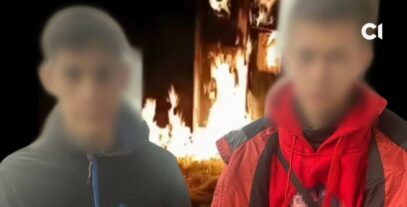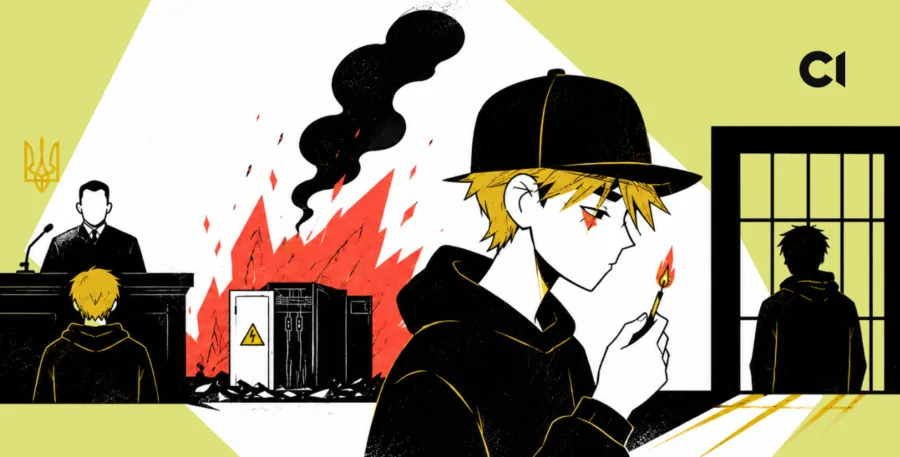
In 2024, Ihor received his first sentence for setting fire to railway relay cabinets on the instructions of a Russian handler — five years’ imprisonment. Because he was a minor, he was released from serving the sentence and placed on probation for two years. In its judgment, the court noted that the boy had fully admitted his guilt, expressed genuine remorse and assisted the investigation in every way possible. Yet within the following month, he set fire to three vehicles belonging to military personnel. He now faces a custodial sentence.
According to the Office of the Prosecutor General, three teenagers in Ukraine have committed further acts of sabotage after already being convicted of a similar offence. Slidstvo.Info tells the story of one of them.
Setting Fire to Vehicles
Fourteen-year-old Ihor first heard about ‘Niko Kovach’ from his older brother Mykola (the names have been changed).
The brothers had moved from a village in the region to Mykolaiv with their mother and adult sister. Their father had died. The family had very little money, but their mother did everything she could for her children: she worked long hours to give them what little money she could and tried to raise her sons to care about their family and be good people. She bought Ihor, the younger brother, a basic phone so that he could attend classes remotely. He later returned to in-person schooling. Yevheniia Poroshyna, a prosecutor with the Mykolaiv Regional Prosecutor’s Office, says that was when the problems began.
‘Their home was very modest, and their clothes were neat but very simple, so the boys stood out among their peers,’ she says. ‘Ihor was mocked because of his appearance, and there were conflicts at school. That was why his mother transferred him to another school.’
The brothers began staying out late in the evenings. They told their mother they had found part-time work. They did indeed have money — but it was not wages. It was cryptocurrency from Russian handlers.

According to investigators, 16-year-old Mykola was the first of the brothers to become involved in sabotage. He had been looking for casual work on Telegram channels when he came into contact with a handler who went by the name ‘Niko Kovach’.
In December 2024, Mykola and his friends set fire to a railway relay cabinet in Mykolaiv. The handler promised him $300 for the job. Other assignments — setting fire to a post office, vehicles belonging to Ukraine’s Territorial Recruitment and Social Support Centres (TCCs), and electrical substations — were offered for several hundred dollars more.
Ihor then began communicating with the same handler, ‘Niko Kovach’. At first, he sprayed graffiti at the handler’s request, but later began setting fire to railway relay cabinets.
‘The brothers live in the same house and commit similar offences, so we believe it was Mykola who gave Ihor the handler’s contact details,’ says Yevheniia Poroshyna.
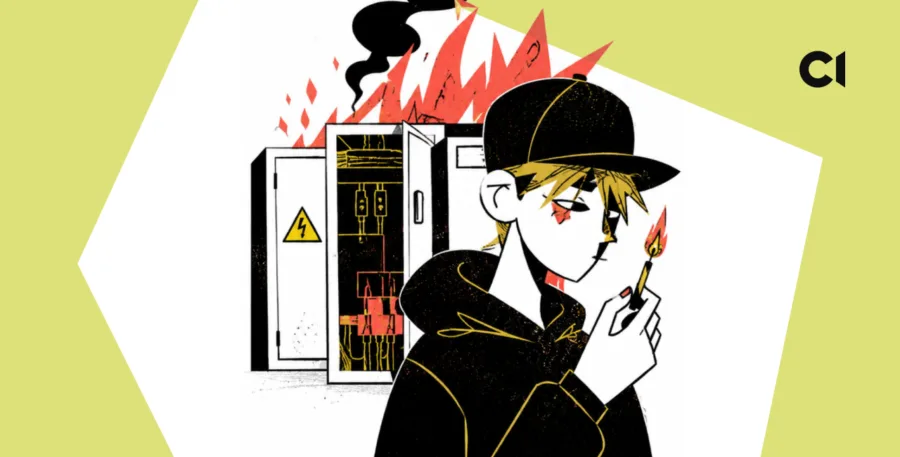
Ihor set fire to two railway relay cabinets on his own. He filmed each arson attack and sent the footage to ‘Niko Kovach’ as proof that he had carried out the assignments. He set fire to a third cabinet on 13 December. Investigators believe that while Ihor was carrying out the assignment by the railway, his older brother was at home messaging the handler about the attack. ‘We’re ready to work,’ he had written the day before.
Ihor returned home, where Mykola, their mother, their sister and her boyfriend were at the time. Almost immediately afterwards, law enforcement officers detained the two brothers.
Electronic devices were seized from everyone in the house, and investigators examined their correspondence with the handler. Yevheniia Poroshyna summarises the messages: ‘The boys were not blackmailed or manipulated. It was all very simple and straightforward — they were offered a way to make money. It seems the brothers did not even ask whether they could be punished for it.’
The boys spent the money on food, a jacket, trainers, sweets, crisps, gifts for a girlfriend and a basic Android phone.
The Sentence
Ihor and Mykola were remanded in custody and held in separate cells at a pre-trial detention centre. They spent four months there.
Poroshyna says the boys behaved well in detention, followed the rules and clearly missed their family. Their mother was able to visit them regularly and without restriction. ‘There is a well-established routine for minors in pre-trial detention, with schooling, plenty of lectures, discussions of books and films, and sessions with psychologists,’ Poroshyna says. ‘For example, to mark Ukrainian Language Day, everyone reads Shevchenko together. There is a gym and a PlayStation. Perhaps I shouldn’t put it this way, but the boys were comfortable in detention. Of course, they were happy when the court changed the preventive measure imposed on them.’
In accordance with child-friendly justice standards, the teenagers were released into house arrest. Their cases were heard separately. Following the pre-trial investigation, Ihor entered into a plea agreement with the prosecution. As a result, the court proceedings were brief.
‘Taking into account the plea agreement, Ihor’s age, his admission of guilt, his active assistance in solving the offence and his family circumstances, the court decided that he would be given a two-year probationary period rather than serve a five-year prison sentence,’ Yevheniia says.
Ihor also paid UAH 30,000 in compensation for the damage caused to the railway relay cabinet he had set on fire. The prosecutor says he was fortunate that the amount was relatively small: in other cases, compensation has reached UAH 100,000. She says they were similarly fortunate that none of the arson attacks caused an accident on the railway running through the city. The consequences could have been far more serious, both for Mykolaiv and for the boys themselves. After the sentence, Yevheniia believed they had reflected on their actions and would turn their lives around.
But just a couple of weeks later, a car was set on fire in Mykolaiv.
A Repeat Offence
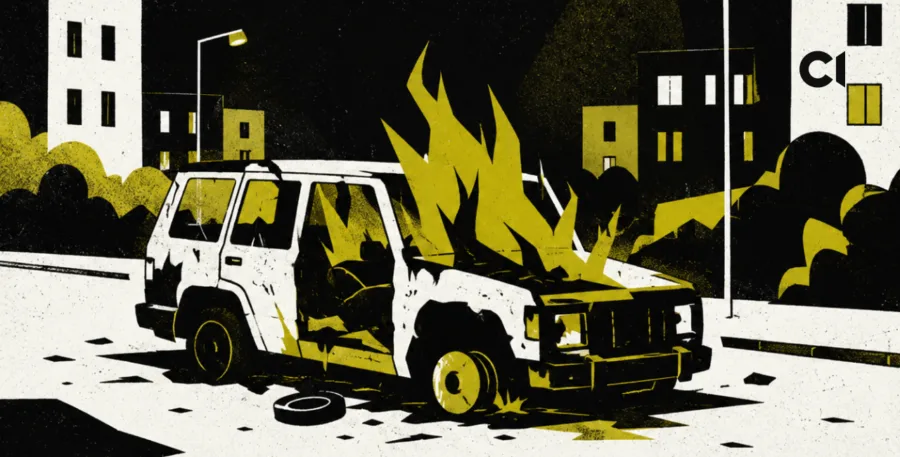
The circumstances were typical. A camouflage-coloured military vehicle with black number plates had been left overnight in a residential area of the city, in the courtyard of a block of flats. Someone poured ‘White Spirit’ solvent into the gap between the bonnet and the windscreen and set it alight.
Two more military vehicles were subsequently set on fire. This time, however, the arsonist was caught: it was Ihor.
He was remanded in pre-trial detention again, with bail set at UAH 484,000. He cannot afford that amount and has therefore been in custody for more than six months.
The case is being heard in closed proceedings because Ihor is a minor. His mother is therefore the only person who visits him.
For these offences, he had been recruited by another handler, who went by the name ‘Andrei’.
Investigators have yet to establish the real identities of the handlers in either case. The instances of recruitment have been incorporated into a broader investigation into the recruitment and use of minors in the war, which constitutes a war crime. So far, the authorities in Mykolaiv region have not identified any of the recruiters who have operated in the region since 2022.
‘I didn’t even ask Ihor how he came into contact with the second recruiter,’ says Yevheniia Poroshyna. ‘He had been through this before and knowingly engaged in the correspondence and entertained the offers. There was no blackmail or coercion. At that point, it no longer mattered who found whom or who sent the first message.’
‘I Don’t Understand What He Thought Would Happen’
With a rueful smile, Yevheniia Poroshyna describes Ihor as a unique case.
‘I was convinced he would change his ways, learn from what had happened and not commit any more offences,’ the prosecutor says. ‘It never occurred to me that he would go down the same path again. We looked at him and thought: what a good kid.’
‘I’ve worked with many minors who have committed similar offences, and not all of them show remorse,’ Poroshyna says. ‘Some are aggressive, arrogant and convinced they have done nothing wrong. In those cases, of course, I do not state in the indictment that they have admitted their guilt. With Ihor, by contrast, there were no problems at all. He co-operated with the investigation and understood the gravity of what he had done.’
Perhaps, the prosecutor adds, he simply managed to fool everyone. His intention to continue committing acts of sabotage may have gone unnoticed because he is reserved by nature, as his mother describes him. After speaking to her, Poroshyna is convinced that Ihor committed another offence because he saw it as an easy way to make money.
Poroshyna cannot understand how Ihor failed to realise that he would be caught a second time — what did he think would happen? The teenager had not even deleted his messages with the handler. He told his mother that he was staying out late walking by the river. On the evening of the last arson attack, she fell asleep before she had a chance to call him and ask why he had not yet come home.
Yevheniia Poroshyna says she tried to imagine his motivations and emotions: ‘He was a teenager from a family struggling financially, beginning to assert his independence and grow up. Then, suddenly, an opportunity came along to make good money. To what extent did that make him feel more important, more respected? How much did it change the way he saw himself? I think that played a part in what he did afterwards.’
His brother Mykola, by contrast, has turned his life around: he works in construction and is taking part in a probation programme. He told the prosecutor that he and Ihor had even fallen out and stopped speaking for a while because his younger brother mocked him for earning money through legitimate work.
Poroshyna saw no signs of pro-Russian views in either Ihor or Mykola. She adds that recruiters never approach teenagers by saying they want them to work for Russia — they talk only about money.
Mykola and Ihor committed their first offences around the time recruiters began operating actively in the Mykolaiv region. Before the arson attacks, Mykola was given a simpler task: to photograph food products in a supermarket. The Russians use such images in propaganda portraying Ukraine as suffering hardship and crisis.
‘Back then, in 2024, recruiters would typically offer 100–150 hryvnias for a first task like that, before moving on to photographing buildings and carrying out arson attacks,’ Poroshyna says. ‘They all followed the same pattern, testing whether a teenager was willing to carry out these sorts of tasks. The children would then get a taste for it: they wanted larger sums and would ask themselves whether there were any new assignments. That was when they would be told how to find and set fire to, for example, a railway relay cabinet.’
Yevheniia adds that this approach often works with teenagers because their critical-thinking skills and ability to understand cause and effect are not yet fully developed. They do not always grasp that, in wartime, their actions may serve only Russia’s interests. The prosecutor suggests that even when an assignment is obviously criminal — such as setting fire to a military vehicle — teenagers may not think about the consequences because their attention is focused entirely on the money they stand to make.
Ihor set fire to two pick-up trucks donated by volunteers and a brand-new van used to travel to military positions. The victims have also brought a civil claim for UAH 1 million in compensation for the destruction of the van.
Ihor now faces between five and ten years’ imprisonment for the offences taken together.
‘I don’t yet know what sentence I will ask the court to impose on behalf of the prosecution,’ Poroshyna says. ‘The severity of the sentence will also depend on Ihor’s conduct, but this time remorse will no longer help him. Whatever happens, he will now receive a custodial sentence.’