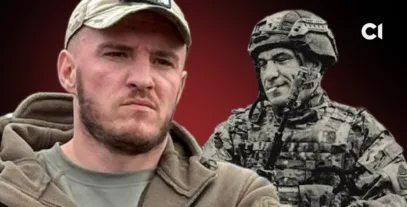
Ukrainian soldier Volodymyr Srebrodolskyi was taken prisoner by the Russians in November 2024 during fighting for Selydove in Donetsk Oblast.
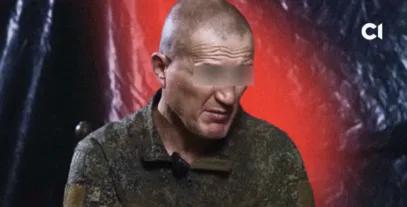
The Russians recorded a video with him in which he made negative statements about Ukraine and the Ukrainian authorities. In April 2025, Srebrodolskyi’s body was returned. But the community where he was born and lived refused to bury him.
Slidstvo.Info journalists spent several weeks searching for the grave of the fallen soldier: they visited cemeteries, called morgues, territorial recruitment centers, and government bodies at various levels. Instead, they encountered silence, lies from officials, and an attempt to smash the film crew’s camera.
“We will not get on our knees, but he needs to be buried”
Near a store in Karpylivka, a village of 500 in Chernihiv Oblast, an elderly man sits.
“Where is the cemetery here?” we ask.
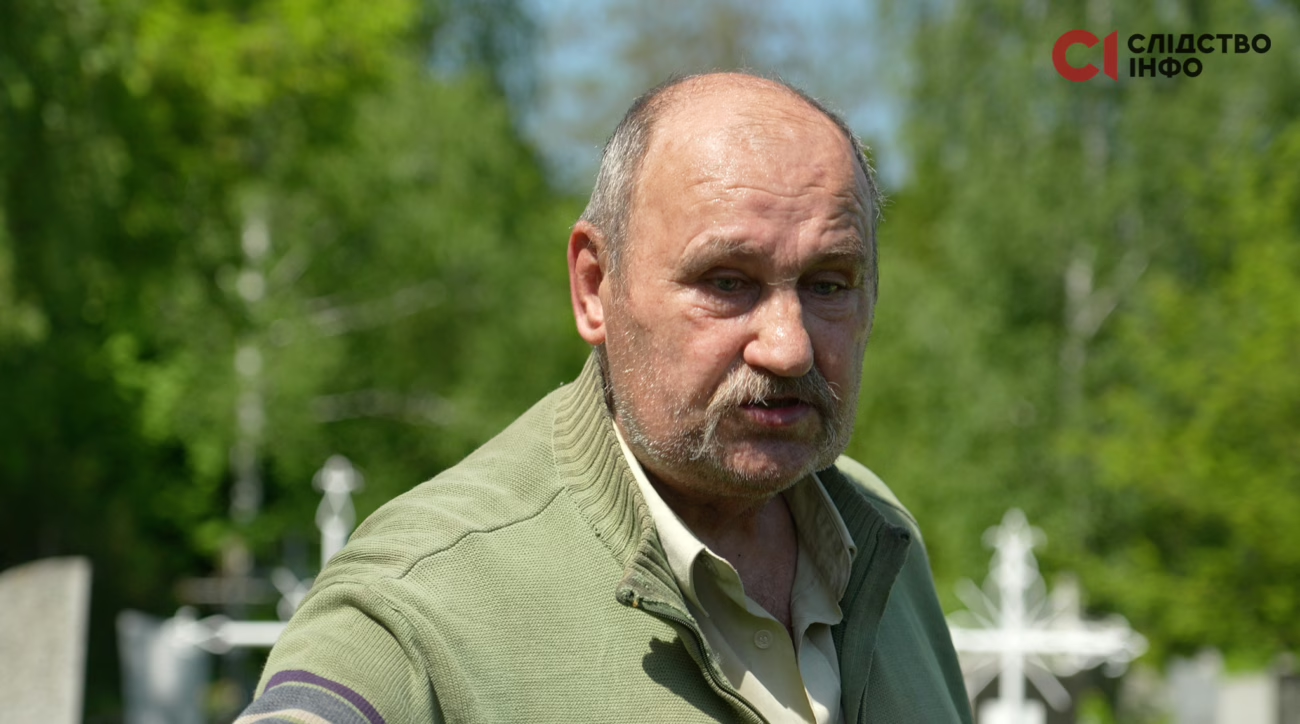
“It is right here, about 100 meters away,” the man says, pointing deeper into the village, and adds, “My son is buried there. He was killed during the Anti-Terrorist Operation.”
The man’s name is Ivan Fedorovych Tatsenko. At the cemetery, he shows us his son Oleksandr’s grave.
“When you buried him, were there honors? Were there fire salutes?”
“Of course, the whole district came. A flag was placed on the coffin.”
We ask Ivan if he knows his fellow villager, Volodymyr Srebrodolskyi.
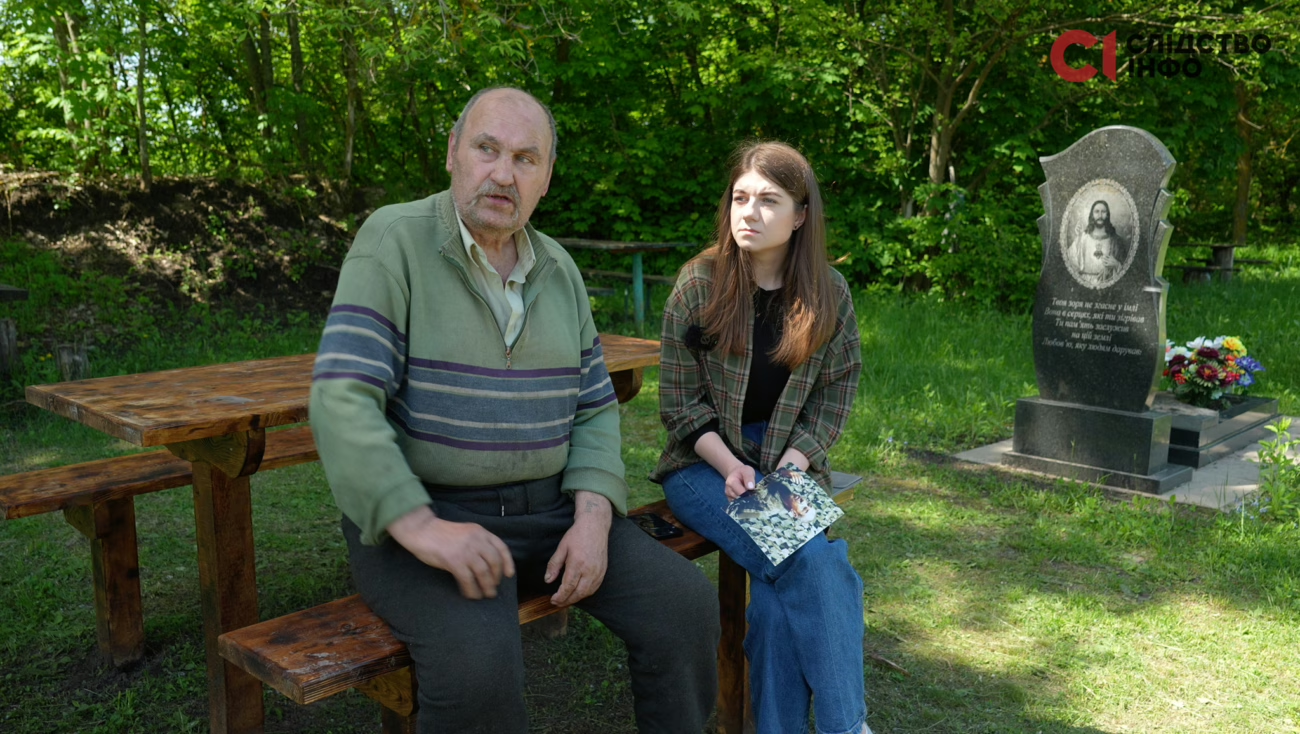
“Bandit!” the man replies sharply.
“What makes you think so?”
“The whole village saw the video. My son lies right here, and that one on the video says: ‘I f*cked Ukraine and everything.’ We told the village council head: ‘We will burn you if you bury him here,’” Ivan says.
At the store in the center of the village, saleswoman Tetiana recalls: “He [Srebrodolskyi] was so cheerful. He would buy groceries, everything as usual. Mostly macaroni, oil, that sort of thing. He fished all the time — any day off, and he was out fishing.”


The man was not buried in Karpylivka, the saleswoman assured us.
To reach Srebrodolskyi’s house, we had to push through thickets. The yard is overgrown. Inside, a partially collapsed wall and a dirty mattress without bedding are visible. Ivan, who gives us a tour, says Srebrodolskyi had no close relatives. He lived alone and worked as a helper at a sawmill.

“We used to come with a friend, and I would cut his hair here. His house was clean and orderly. Even though he drank, he kept order,” the man recalls while looking over the neglected house.
A school photo of Volodymyr hangs on the wall. I hold up another picture – a frame from the Russian video recorded in captivity – to accurately compare the likeness. Between these two photographs lies almost the entirety of the man’s life, and we still cannot find his grave.

As we leave, a woman rides past on a moped along the village road. We stop her and ask about Volodymyr. She says she went to school with Srebrodolskyi.
She speaks cautiously about the video from captivity. There were people in the village who opposed burying Srebrodolskyi in the community. But not everyone: “Most leaned toward burying him like an ordinary person, since things turned out this way. Next to his mother.”
Srebrodolskyi’s neighbor repeats, “We genuinely did not bury him. We would have heard about it, this is a village… I am already thinking, why drag him around? We will not get on our knees, but he needs to be buried.”
“But I ain’t dyin’ for this damn, clueless government”
It was the very video the Russians recorded with Srebrodolskyi in captivity, which Russian Telegram channels spread, that became the reason the people of Karpylivka did not want to bury their fellow villager. In the recording, Volodymyr Srebrodolskyi smokes a cigarette and says in Russian: “But I ain’t dyin’ for this damn, clueless government. I still want… I’m 55. I want a couple of years—if God grants me that. To live somewhere in peace. Not in this Ukraine.”

Military medic Mykola Shustrov, who was in captivity with Srebrodolskyi, insists that everything said on the video was done under duress: “Srebrodolskyi said: ‘They filmed a video with me, told me what to say so I would not say anything extra.’ They said that this video would definitely be seen in Ukraine and they would see that you are alive,” Shustrov recalls.
According to the former prisoner, such recordings were made with almost all Ukrainian captives. After being taken prisoner, Srebrodolskyi was taken to a penal colony in occupied Torez. It was there, according to Shustrov, that the man began to be brutally beaten: “When they bring you to the colony — they beat you immediately. This is the so-called ‘initiation,’” he explains, adding: “And then they beat him again for not learning the anthem well enough.” Shustrov recalls that the last beating was especially severe: “They hit him in the stomach.”

After that, Srebrodolskyi’s condition deteriorated sharply. According to a former prisoner who was a medic, the man developed peritonitis—an acute inflammation of the abdominal cavity. He received almost no medical care.
“Overnight, they moved him from the disciplinary isolation cell. He told me they’d beaten him. He was getting worse and worse. The ambulance just wouldn’t come,” Shustrov recalls, adding: “When the ambulance finally arrived, they wouldn’t let it in. Nobody there gives a damn about a prisoner. You’re not a person in there—you’re just a captive.”
The fact that Volodymyr Srebrodolskyi died after a brutal beating in captivity is now being investigated by Ukrainian law enforcement. In response to a request from Slidstvo.Info, the Kharkiv Oblast Prosecutor’s Office reported: “After repatriation of the body, a criminal proceeding was opened into cruel treatment of a prisoner of war under Part 2 of Article 438 of the Criminal Code of Ukraine (violation of the laws and customs of war -ed.).”
The position that the video was recorded under duress is also confirmed in the 152nd Separate Jaeger Brigade, where Srebrodolskyi served before captivity.
Brigade press officer Kateryna Myronchuk says the command considers the words spoken on the video by their fighter to have been made under physical and psychological pressure while in captivity.
The brigade also emphasizes that Srebrodolskyi did NOT surrender voluntarily and continued to carry out combat missions with his unit until the very end.
“We’re not talking about someone who willingly surrender. He didn’t run, didn’t panic, didn’t abandon his brothers-in-arms, didn’t betray those beside him,” says Myronchuk. “It’s easy to shape opinions based on rumors, emotions, or someone’s stories in the community. But no subjective opinion can outweigh the facts, honor, service, and the real circumstances a soldier found himself in.”
“We’re calling the police right now—they’ll take you away”
We couldn’t find out where—or if—Srebrodolskyi was buried, neither at the cemetery nor from neighbors or other villagers. So we head to the village elder’s office. But it’s closed.
“I have the same information you do,” says Ihor Brynza, the elder of the Karpylivka district, over the phone. When we ask who does have the information, he replies, “I don’t know,” and hangs up.
Karpylivka is part of the Sribne territorial community, so we head to the village council in Sribne. There, we’re told that the village head, Olena Panchenko, is unavailable as “everyone’s at a sybotnyk (community cleanup day, which usually takes place on Saturdays -ed.).” Though it’s Tuesday. Today is her official reception day. When we try to approach Panchenko’s office, a man who introduces himself as a “contracted worker” starts pushing us out of the building.
“We’re calling the police right now—they’ll take you away,” he says.
Within seconds, the man is shoving me out of the council building. The cameraman raises the camera—and the man slaps it with his hand. The camera hits the floor. After that, a woman comes out, introducing herself as Nina Bondarenko, the deputy village head.


“I apologize for any misunderstanding,” she says.
When asked about Srebrodolskyi’s burial, she gives the same answer as the elder of Karpylivka: “I don’t have that information.”
On the Alley of Memory in the center of Sribne, there are photos of the community’s fallen and missing soldiers. Volodymyr Srebrodolskyi’s name and photo are not among them. Nor are they on the Alley of Hope.
After Sribne, we head to Pryluky. This is the third cemetery where we’ve searched for the grave of the soldier tortured to death in captivity. But even in Pryluky, among the graves marked with blue-and-yellow flags and wreaths of the same colors, we can’t find Srebrodolskyi’s burial site.
“The body did not come to us. If they had brought it, would we not have buried him?”
Returning to Kyiv, we began sending inquiries with one simple question: where was Srebrodolskyi buried?
The second department of the Pryluky district territorial recruitment center stated that the Sribne territorial community handled the burial. The Sribne community said by phone to ask the territorial recruitment center.
The deputy head of the territorial community, the same Nina Bondarenko we had already met in Sribne, now said by phone: “The body did not come to us. If they had brought the body, would we not have buried him?”
But in a letter signed by community head Olena Panchenko, which we received a week before the trip to the village and before this phone call, it says: “Ritual services regarding Volodymyr Ivanovych Srebrodolskyi were provided in full.”
So we started checking morgues—what if Srebrodolskyi’s body still hasn’t been buried? The Main Bureau of Forensic Medical Examination at the Ministry of Health told us our request had been “passed to the lawyers.”
“Call back tomorrow, please—we’re in the middle of a reorganization right now. Everything’s been dumped on them. They’re swamped, and so are we,” said people at the bureau.
The Chernihiv Oblast territorial recruitment center refused to provide information about Srebrodolskyi’s burial, citing privacy concerns, since his relatives had not authorized the disclosure of personal data. The problem with this response is that, as we were told in the village where Volodymyr was born and lived, he had no relatives. No one was even available to go to the morgue to identify his body.
In the same letter, the Chernihiv territorial recruitment center accused Slidstvo.Info of being “commissioned” to investigate where the tortured soldier Srebrodolskyi was buried.

“He deserves proper honors. This is the duty of the entire country”
Taras Ishchyk, a soldier in the Ukrainian Armed Forces who works on memorial culture, says that when a soldier with no family dies, the responsibility falls to several bodies: both the local community and the local territorial recruitment center. But when responsibilities are split, accountability can get murky.
“What’s missing in this process is a single dedicated authority to handle military burials. Any servicemember who didn’t break their oath—whether they died in active combat or in captivity—deserves proper honors and a burial with full military respect. This is, in essence, the duty of the entire country to ensure that happens.”
The only person who finally provided information about Srebrodolskyi’s burial was the press officer of the 152nd Brigade, where the soldier had served.
Kateryna Myronchuk explains that when the scandal over burying him in his home community began, plans were made to inter him at the National Military Memorial Cemetery. Upon learning this, the local community agreed to bury their fellow villager in the local cemetery.
Myronchuk chooses her words carefully: “But later, circumstances arose in which the community could no longer bury this serviceman…”
In the end, Myronchuk concludes, the burial was arranged in Pryluky with the assistance of the Chernihiv city military administration.
“Who is capable of fulfilling their duty to the end”
In Poltava Oblast, where the 152nd Brigade was formed, an oak grove has been planted in the middle of a field. Among the newly planted trees, white stone memorial plaques are visible, each inscribed with the names of the brigade’s soldiers who fell in the Russo-Ukrainian war. On one of the plaques, we read the name: Volodymyr Srebrodolskyi.
“War doesn’t divide people into the convenient and the inconvenient. It reveals who is capable of fulfilling their duty to the end,” says the brigade’s press officer, Kateryna Myronchuk.