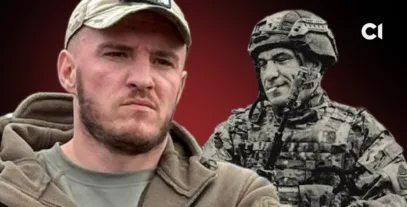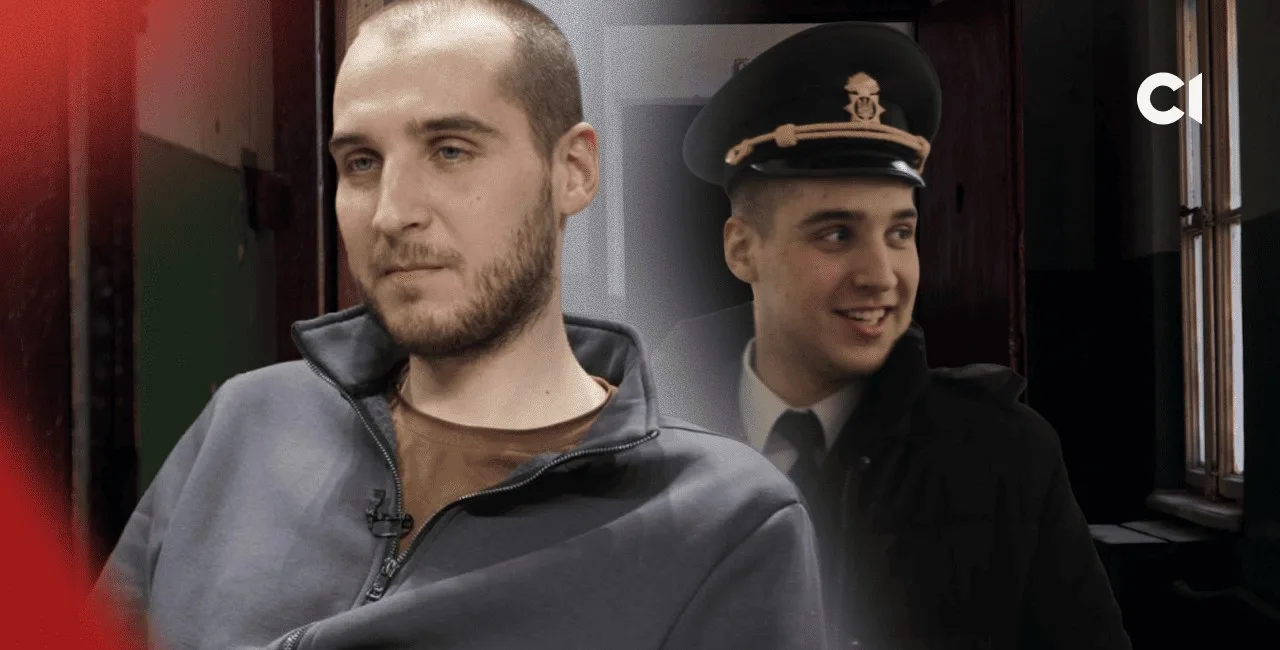
National Guard member Dmytro Sirenko joined the army even before the full-scale war. He defended Mariupol and sustained serious wounds during the fighting. From the Illich Iron and Steel Works, he was taken into captivity, where he spent 1,427 days.
Dmytro was held in the Sukhodilsk penal colony in occupied Luhansk Oblast. Prisoners were tortured, starved, and forced into exhausting labor there. Despite that, Dmytro tried to stay positive and even joked in captivity.
Slidstvo.Info’s full story is titled Driven to suicide because of a ‘Glory to Ukraine’ tattoo: A soldier speaks about those tortured in captivity.
“Dima is a former prisoner of war. To be precise, he spent 1,427 days in captivity. I do not think it is all that sad,” Dmytro Sirenko says with a smile, adding, “I am more positive in that regard. Although my call sign was ‘Negative’.”
Dmytro joined the army even before the full-scale war, first for his mandatory conscription.
“I signed up for conscription in 2018. They told me it was too early—I was only 19 at the time. I went to the military enlistment office, and they said, ‘You’ve still got a year to enjoy yourself; we take people from 20.’ I told them, ‘No, let’s do it now. I’ll serve my time, and then you won’t bother me again,’” Dmytro recalls.

Later, he decided to stay in the army: “I am doing my conscript duty, thinking: no, this is nonsense, let’s sign a contract.”
He recalls with a smile which unit he serves in, because captivity made him miss the updates: “It used to be the 9th Operational Purpose Regiment, and now it is the 15th Brigade… Kara-dag, Karabakh… I have not learned it yet. They just told me that I serve there. But the flag is beautiful, and the unit is elite.”

47 days of war: “Like a colander… extra holes appeared”
At the beginning of the full-scale invasion, Dmytro Sirenko was in Mariupol.
“The commander comes in and says, ‘We need 10 men for reinforcement.’ And there I was, just sitting around, sipping juice, eating Snickers. He goes, ‘Come on, Dima, you’re up.’ I’m thinking, ‘Why me? I wasn’t bothering anyone, just minding my own business’ (laughs). If I were to tell you about all my combat ‘adventures,’ it’s a short story—I only ran around for 47 days before I got wounded. Not much… I wanted more. And then, to top it off, I ended up in captivity so embarrassingly,” Dmytro shares.
During one of the building assaults, Dmytro was wounded: “I turn my back—bang. I look down, and my leg is bleeding, warm blood just flowing… ‘Carry on with the assault without me.’”
After the wound, the situation around him and in Mariupol in general only got worse.
“There were only five of us left—everyone else had already bolted. They took the radio, leaving us with nothing. Then something exploded right under me—I was stunned. I hit the ground, shouting, ‘I’m WIA!’ I turn around and see everyone running back. I thought, ‘Got it.’ I start running back, and then a mortar shell lands right at the door. I drag myself past everyone, on all fours, my legs already shattered, and then I black out,” Dmytro recalls.

When Dmytro came to, he tried to make his way to the evacuation point on his own. He ran about three kilometers despite the shelling: “Under the bridge, there were some figures—I didn’t know if they were friend or foe. They’d shout, ‘Enemy!’ and I’d drop. Then, ‘No, ours!’ and I’d get up. Then again, ‘Enemy!’—I’d drop again. This happened three times. At that point, I thought, ‘Screw it, friend or foe—I’m out of here.’”
He was taken captive at the Illich Iron and Steel Works along with other soldiers: “Some big shots up top had worked out a deal. There was a vehicle for the wounded, loading everyone up. I’d just managed to get online and messaged my family that I was surrendering.”
Even then, Dmytro tried to keep things light with his family, using humor instead of drama: “I wrote everything with sarcasm. I told my mother-in-law, ‘That’s it, my legs are gone.’ Then, ‘Nah, just like a colander.’ She asked, ‘What do you mean?’ Well, full of holes—extra holes appeared. I wrote to my wife, ‘Don’t curse me, just live and enjoy yourself.’ She replied, ‘Are you crazy?’—and immediately added that she wanted kids.”

“I told her, ‘No problem, you know how many free men are out there—just pick someone else.’ She says, ‘I want yours.’ I’m like, ‘Are you serious? I’ll be in captivity. Don’t turn yourself into a nun. You’re young, beautiful—she’s 21, I’m 22. Am I some kind of tyrant? I didn’t know how long I’d be stuck there. Almost four years…’”
“So, are you still in touch with her?”
“Yeah.”
“Did she wait for you?”
“Well, looks like it.”
Sukhodilsk colony: “Our lot beat the hardest”
After leaving the Illich Iron and Steel Works, Dmytro, along with other wounded soldiers, was taken to the first detention site—barracks in Sartana (a district of Mariupol–ed.): “It was horrendous there. I don’t remember exactly—4 or 6 barracks—but each held 500–600 people. Just a crowd. A square, maybe 20 by 20 meters, and they crammed everyone in there.”
Dmytro only spent a few days there, in unsanitary conditions and with hardly any food. He recalls, “I was wounded. I went to the guys and said, ‘I need my dressing changed.’ And they were given bandages that looked like they had already been used. They just changed my wound packing.”
At first, Dmytro says, the guards gave one small can of porridge—about 200 grams—per day to be shared among four prisoners. Later, they divided the same portion among ten. He was then transferred to Olenivka, where he remained for a few days before being sent to Sukhodilsk Penal Colony No. 4 in the occupied part of Luhansk Oblast. That’s where he spent nearly three years.


According to Dmytro, despite his serious condition after the wound, he did not receive proper medical care. Instead, prisoners were systematically forced into exhausting physical exercises.
“When you’re forced to do 500–1,500 squats in a short time, when you stand in an uncomfortable position for hours, when you march in single file for 500 meters back and forth… Your legs just give out. I get that exercise is good for you, but in moderation. When you’re not eating properly, when you have no vitamins—it just destroys your body.”
Dmytro separately recalls one of the colony’s leaders, whom the prisoners called “Kalivan”: “He was responsible for our ‘pumping’ — excessive physical exercises. It did not happen without him.”
Dmytro Sirenko also described at least four fatal cases among Ukrainian prisoners of war. Slidstvo.Info identified Kalivan as Vitaliy Kartyshkov, the deputy head of Sukhodilsk Penal Colony. Investigations indicate his involvement in the brutal treatment of Ukrainian POWs.
Journalists have identified three more colony employees whom former prisoners recognize as participants in torture and beatings. Some of them have already been formally charged.
“Hello, my onion roll sweetheart”
For almost four years in captivity, Dmytro received no letters from his relatives at all, except for one.
“On January 15, 2026, the Red Cross delivered my first letter. I opened it, and my wife had written, ‘Hello, my onion roll sweetheart.’ I immediately wanted to write back. I thought, what should I say? ‘Hello, my love’—too cliché. ‘Hello, Violetta’—too cliché. ‘Hello, Vilka’—didn’t feel right either. Then I thought, ‘Ah, ‘Hello, poor thing’—that sounds good,’” Dmytro smiles. But in the end, no one ever let him send a reply.
Letters in the colony were an event for everyone.
“There was this guy, Sania, in our cell. His girlfriend sent him, like, 15 letters—he was the richest in letters. We were so jealous. I told him, ‘Dude, you’re engaged—imagine, you’ve got a four-year fiancée.’ Not a wife, a fiancée, because she’s been waiting four years. She writes to him: ‘I got into school, bought something, my mom gifted me a Spitz.’ He reads ‘Spitz’ and goes, ‘That’s not even a dog.’ Then he keeps reading—she’s allergic to dogs—and he’s like, ‘Thank God,’” Dmytro says, laughing.
These little things, he says, brought back a sense of normal life, the feeling that you weren’t alone: “If you can, write. Maybe at least one letter will get through. But it instantly lifts the guys’ spirits.”
From Sukhodilsk, Dmytro was transferred to another place of detention located in Cheboksary (Russian Federation). There, he says, the attitude was similar to Sukhodilsk, accompanied by torture. Dmytro says that the last days before returning from captivity were the hardest.
“I didn’t sleep a single minute those two days—I didn’t drink, didn’t eat anything. I didn’t know the body could handle that. But I just knew: I was going home.”
The road home was also exhausting.
“I’m riding in the prison van—no space, my knees hurt, I can’t even stretch out. They gave me a bottle with a tiny opening—how am I supposed to drink from that? It’s impossible. But you just sit there and think: I’m going home—and nothing else matters,” Dmytro recalls.
Dmytro returned as part of a prisoner exchange on March 5, 2026. He is currently undergoing rehabilitation with other released POWs. He shares how his perception of the simplest things has changed: “I got back, ate—and suddenly wanted nothing more. Because now I can eat as much as I want. I can talk to whoever I want. I can do whatever I want. Everything else is just trifles.”