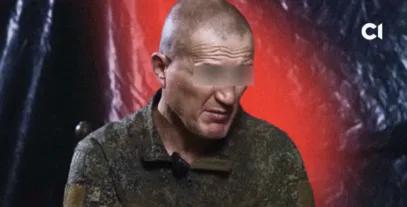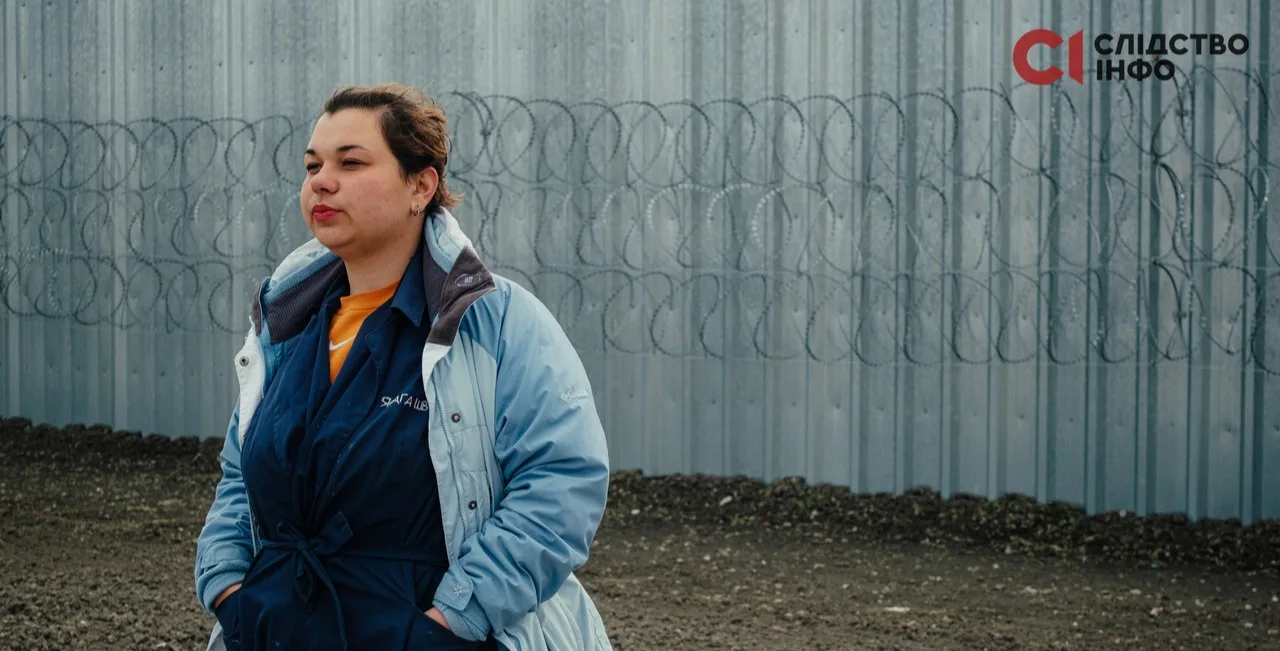
“Worked for the occupation authorities. The Russian Federation provided humanitarian aid, and we distributed it,” Anastasiya Yasagashvili described her work for the Russians in one interview.
The woman, later convicted of treason, soon testified about how she rode with Russian security forces to detain Azov fighters, befriended FSB employees, carried a pistol and an automatic rifle, and helped find weapons caches almost on a daily basis.
The newsroom compared her words with the case files. It turned out she had even fabricated facts from her own biography.
For nearly half an hour, soup is poured into metal bowls, and vegetables, porridge, and cottage cheese are added. The cups are filled to the brim with milk. Gradually, the line of women in blue robes and headscarves thins out, and they take their portions and sit down at the tables. Lunch barely fits on the trays, and most have to stack plates into pyramids.

This is a unique penal colony where only women who agreed to cooperate with the Russians serve their sentences. A television hangs on one wall of the dining hall, so during every meal the convicted women can watch the United News telethon program. Today, the broadcast features a report on the consequences of Russian airstrikes. But this appears to be the only source of information about the situation in Ukraine and the world that the women ignore — they do not even look up at the screen.
Some glance disapprovingly at the film crew and cover their faces with their hands to avoid the camera. One of the oldest convicted women, who looks well over 70, pointedly gives the middle finger to the lens.

Later, colony staff explain that as soon as the conversation turns from distant consequences of attacks to a specific, nearby air raid siren that sounds inside the colony, the women perk up. Some of them rejoice, saying that Russia is “coming to liberate them.”
One woman who would rather live in Russia than serve her sentence in the colony is Anastasiya Yasagashvili, sentenced to 15 years for treason. Nastya is now 23. When she began working for the Russians, she was only 19.
For the interview, which Yasagashvili voluntarily agreed to, she prepared by tying her hair back in a ponytail and applying makeup to her eyes and lips. This is not her first time being filmed directly in the colony, yet each time, new and different facts emerge from her.

BEFORE THE FULL-SCALE INVASION
Nastya Yasagashvili comes from the village of Shevchenkivske in Zaporizhzhia Oblast. She finished nine grades and then enrolled at the Zaporizhzhia Vocational Education Center to train as a crane operator in metallurgical production.
Yasagashvili claims that after two and a half years, she left the school because she “is terribly afraid of heights.” Instead, she chose to dedicate her life to military service.
“I submitted documents to the Suvorov [Military] School in Odesa. I wanted to join the military. Not because I wanted to take up arms or anything like that. By my nature, I am that kind of person — disorganized, one could say. I wanted to learn some discipline, so that everything in my life would be like what normal people have. It was either prison or army. I had no plans for prison,” Nastya says, laughing. “I really liked it. I studied there for one year and two months.”
She says she could not finish her studies because of pregnancy: “I left in the seventh month of pregnancy. Maternal instincts awakened in me, and I wanted more security.”

Slidstvo.Info checked Yasagashvili’s claims about supposedly studying at the Suvorov School in Odesa. It turned out she invented this, since Suvorov schools have not existed in Ukraine since 1992, as they were reorganized into lyceums. The Odesa Lyceum with Enhanced Military-Physical Training told Slidstvo.Info that Anastasiya Yasagashvili had never been a student there.
Eventually, during an hour-long conversation, Nastya even recalled supposedly having completed studies at a military school: she said that every class gets a tattoo of the branch emblem, and she had a trident inked on her wrist. Yet in other interviews, she gave different versions. For example, in an interview with Volodymyr Zolkin, Nastya claimed she could not remember the circumstances under which she got the tattoo. So, when exactly Yasagashvili got the trident remains unknown.

In June 2021, Yasagashvili became a mother. Her daughter was seven months old when the full-scale war began. Russian forces occupied her village on March 2. For Nastya’s family, the occupation was especially dangerous as her husband’s parents serve in the Ukrainian Armed Forces. The Russians learned about this anyway — but not from strangers.
“FSB EMPLOYEES — GOOD ACQUAINTANCES, COMRADES, COLLEAGUES”
Nastya describes the beginning of her cooperation with the Russians as an accident. She says that in the first days of the occupation, she went to the town and on the way saw Russian troops driving onto her father’s field. Nastya recalls what she supposedly told them:
“‘Where are you going, idiots? Go around like this, like this, so you do not damage the land.’ Because they will tear it up, and then we will not be able to do anything with it at all.
According to her, a few days later, Russians came to the village for a clearing operation, saw her, and asked if she was the one who had explained how to drive around. Nastya said yes. So the Russians asked if she knew her way around. She supposedly answered evasively: “Anything is possible.” After that, she was offered cooperation.

The court verdict states that Nastya agreed to this voluntarily and even showed initiative. The woman herself claims she worked as a cartographer, helping the Russians with logistics. However, her cooperation did not end there.
Yet in every interview, Yasagashvili tells a different version.
“Worked for the occupation authorities. We had to distribute humanitarian aid to people. The Russian Federation provided it, and we distributed it,” Anastasiya said in an interview with Radio Free Europe/Radio Liberty.
In October 2025, Yasagashvili gave an interview to blogger Volodymyr Zolkin. In it, she generally tried to conceal what exactly she did during the occupation. She said,“If I say what I was really doing, the consequences will be completely different.”
The investigation proved that Yasagashvili helped the Russians search for caches of Ukrainian weapons. She does not deny this. On the contrary, in the interview with Slidstvo.Info, she cannot even recall how many times it happened: “I cannot remember, because it was almost on a daily basis. Everything I do, I do with such serious enthusiasm. I am a jack-of-all-trades, everything interests me.”
Yasagashvili also recalls how she rode with “her operational group” to detain Azov service members and marines. Almost with pride, she says, ”We arrived to detain the Azov fighters. They came out from the Azovstal [steelworks] through underground passages. They scattered across the villages. But at that moment, it was morally hard for me to watch how people were being arrested. I do not like it when someone breaks in and shouts:
‘Face to the floor!’ or something like that. For me, it is vulgar and horrifying. Everything should be done properly.”
When speaking about her work for the Russians overall, Nastya does so with enthusiasm and takes pride in her warm relations with the occupiers. She says she even traveled to Moscow “on business” with an FSB employee.
“With FSB employees, I mostly communicated not as with officials, but simply as with people,” Nastya says. “We were like acquaintances, good acquaintances, comrades, colleagues. I had the same kind of relationship with the head of SOBR (Special Rapid Response Unit — ed.) and with the head of OMON (Special Purpose Police Unit — ed.). Well, I am that kind of person: I befriend everyone until something happens. If someone really offends me, my good relations end. It has always been like that. When I came here, I also had wonderful relations with the SBU.”

TURNED OVER HER FATHER AND HUSBAND TO THE RUSSIANS
Communicating “simply as with people” also meant that Nastya turned over even her own relatives to Russian security forces. This is mentioned in one of the episodes in the verdict under which she was convicted of treason. The investigation proved that Nastya pointed out to the Russians her husband’s mother and stepfather. They are Ukrainian Armed Forces service members who were in Zaporizhzhia at the time. Uniforms and equipment belonging to them were stored at Yasagashvili and her husband’s home.
Daryna Kulichenko, head of the information policy department of the Zaporizhzhia Oblast prosecutor’s office, added in a comment to Slidstvo.Info that In June 2022 the Russians took Nastya’s husband and his sister to the “basement” and demanded that the sister call her mother and persuade her to come to the occupied territory. After the call the woman was released, but her husband spent two weeks in detention. Kulichenko noted that Yasagashvili repeatedly visited her husband in captivity, but not to support him: “[Anastasiya] said that if he wanted to get out of there, he had to provide information about pro-Ukrainian residents of the village. She suggested that [her husband] turn in her own father, who had taken weapons and ammunition from an abandoned Russian truck and was keeping them at his home.”
Eventually Nastya herself turned in her father to the Russians. His place was later searched and everything was confiscated.

Yasagashvili herself denies that her husband was sent to the “basement” because of her. She says that everyone in the village already knew about his parents’ service in the military.
As soon as her husband was released, she, her husband, and their daughter left the occupied territory for Zaporizhzhia in July 2022. According to Nastya, her relationship with her husband was “consistently bad,” and they made the journey together only for the sake of their daughter.
Yasagashvili’s version is that she had to leave because the occupation authorities learned that her husband’s parents served in the Ukrainian Armed Forces and could no longer work with her. Here Nastya contradicts herself again: earlier she said that the Russians took her husband to the basement already knowing that his parents were Ukrainian service members.
The official investigation’s version is completely different: Yasagashvili was traveling to Zaporizhzhia to continue working for the Russians and recruit future agents on free territory.
“THIS IS NOT A MOVIE!”
After leaving the occupied territory Yasagashvili called the SBU and confessed that the Russians had recruited her. She then corresponded with Russian security forces under the control of the Ukrainian security service. Nastya recalls: “I started visiting the SBU often and we signed cooperation documents. Since I still had these contacts (with Russian security forces — ed.), they introduced me to SBU operatives with whom I worked further. They, so to speak, mostly dictated what to write.”
According to Yasagashvili’s version, cooperation with the SBU failed because one day she told her Russian “boss” about working for the Ukrainian security service.
But she chose to stay silent in the interview about what else she did to sabotage that cooperation. From the verdict it is known that on instructions from the Russians she met with Ukrainian Armed Forces service members and asked where their bases and equipment were located. Then she passed everything on to “leadership” via Telegram.

Here are the messages her handler, saved in her phone as Vadim, sent to Nastya: “Meet someone from the Ukrainian Armed Forces somewhere in the center, attract his attention. Take a few photos with him. You need to try to steer him into a conversation about the war and so on. Go for a walk, and find out where they live and where their base is located.”
Another handler under the pseudonym “Coordinator” gave Nastya other tasks: go to a certain location, take photos and video, check whether weapons are stored there.
“This is not a movie! This is work for the good of our country!” he wrote.
The tasks for Yasagashvili were not limited to reconnaissance in the area. According to the verdict, she was also supposed to meet with a girl named Yana and prepare her to work as an agent. Whether this girl existed and whether the meeting took place is unknown from the document, but here is how the Russian handler advised Nastya: “Find some remote place, in the evening take equipment and you will train her.”
At Nastya’s trial almost her entire family testified against her. It is unpleasant for her to talk about this, but memories of her daughter evoke even more emotion. “I do not think this is a good topic for conversation,” Yasagashvili cuts off in response to my question. The girl is now 5 years old, but since her imprisonment in 2022 Nastya has not seen her child. Her ex-husband filed a lawsuit to strip Yasagashvili of her parental rights.
“What I did, from all sides shows that I am not worthy of my daughter. Of course, I do not want them to strip me of my parental rights,” Nastya says. “But I understand that this is how it will be. So if I cannot change the situation, I must change my attitude toward it. That is all. In everything that happened, I alone am guilty. But what happened, happened. Come on, take this all off me,” she finally says, pointing to the lavalier microphone for the interview recording.
Yasagashvili stands up irritably and walks out of the hangar to smoke.