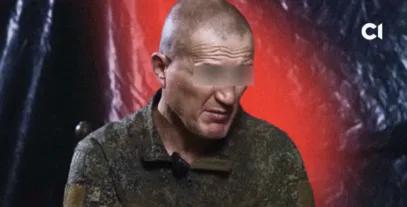
Slidstvo.Info journalists gained exclusive access to a rehabilitation center where Ukrainian service members recover after being held in Russian captivity. Here, they undergo physical and psychological rehabilitation: they rebuild muscle strength, relearn how to move, sleep, and live without constant tension.
Doctors treat the consequences of beatings, electric shock torture, injuries, and prolonged exhaustion — and they say the hardest part is not only healing the body, but also enduring the stories they have to hear.
This is the focus of the Slidstvo.Info report titled Driven to suicide because of a ‘Glory to Ukraine’ tattoo: A soldier speaks about those tortured in captivity.
Dmytro Sirenko knocks on the office door.
“May I come in?”
The man was released from captivity on March 5, 2026. Now he undergoes rehabilitation every day and speaks about the procedures casually — as if they are something routine.

“Whenever I say I am going for treatment, everyone asks, ‘Which one?’ I reply, ‘I am going to have my back shocked.’”
“And?”
“I say: ‘I am loving it.’”
He is talking about electromyostimulation. Ten minutes of impulses — and the muscles contract without any load. Dmytro lies on his stomach while the nurse sets the current strength.

“Let’s go higher. It is too weak.”
He smiles and closes his eyes.
“I am just lying here. I actually want to rest.”
He says this is his favorite treatment of all.
“It feels like a massage, a pinpoint one on the back.”
Then he adds, now without joking:
“In captivity, they used 10–15 thousand milliamps with stun guns. Here it is 8 milliamps. Of course, it feels different.”
Next to Dmytro is Dr. Albina. She adjusts the settings and watches his reaction.
“How does it feel?”
“My feeling is that the first time was stronger.”
She increases it.
“Maybe you attached the electrodes poorly?”
“No, everything is fine.”
The impulses pass through his back, and the muscles contract rhythmically. Dmytro lies still, reacting only occasionally to changes in current strength.
“Let’s set it to ten next time.”
“Fine, as you say.”
The treatment lasts ten minutes. Afterward, he immediately compares it:
“Still a bit weak. Or maybe I have already developed immunity to electricity.”
And he returns again to the difference he feels in his body:
“There, of course, they gave the maximum. And here … well, it is different.”
Albina says electromyostimulation is one of the basic procedures for restoring muscle function. She works with those who have just returned from captivity and selects the current strength individually and gradually.
During the procedure, she constantly checks:
“Does it hurt?”
Dmytro only jokes back:
“You should try it too.”
Employees at the center say reactions to such procedures vary. For some, it is ordinary physical therapy; for others, it is more difficult because the body remembers the experience.
That is why they start carefully — with minimal loads and constant monitoring.
“They shock you, drown you, cut you”
Otolaryngologist Oleksiy Dzhirov says that before starting treatment, they ask the released prisoners in detail what exactly happened to them, for how long, and by what methods: “This includes a full description of the tortures, what occurred, the frequency and duration of all those tortures. Fractures of the nasal bones, blows to the ears that end in ruptured eardrums.”

But Russian jailers do not stop there, the doctor says: “They beat you with batons, what they call ‘tapiki’ — old field telephones they use to deliver electric shocks. Drowning, beatings, burn torture, cutting — he has seen it all.”
The doctor admits that it is hard to endure, even for experienced medical professionals.
“Sometimes, after certain stories, you just want to shut yourself away. You cannot understand how people could survive something like that and remain sane.”
In the rehabilitation hall, Dmytro is asked to stand in front of the mirror.
“Are you kidding? I have no muscle mass. I will look like an anorexic girl.”
They explain to him that it is important to see himself and control his movements.
“We put our hands on our hips. And we begin. From toe to heel.”
He does it carefully, at half strength.
“Can we skip the squats?”
“These are half-squats. At 30 degrees.”
“Even more reason — let’s skip the squats.”
They persuade him.
“You need this. Do you want to restore your muscles?”
He agrees and steps onto the machine.
“Half-squat. One.”

A few months ago he was also doing squats — but differently.
“A hundred times is child’s play.”
“And how many?”
“One and a half thousand, I think.”
“How did you feel then?”
“I could not feel my legs.”
“Here it is much better. Both morally and physically”
Vladyslav is another patient at the center. After the exchange, he is also undergoing rehabilitation.

He says he feels much better now than in the first days after his return.
“Here it is much better. Both morally and physically.”
He lies with his eyes closed — undergoing electrosleep therapy. Through weak electrical impulses, the body is supposed to gradually sink into a state close to sleep.
“I am not sleeping. I am just lying here.”
Vladyslav smiles but adds that he still has sleep problems.

The center says this is one of the most common complaints among those released from captivity. Sleep disturbances, anxiety, and exhaustion — these are what they work with every day.
“Those released from captivity are not adapted to the surrounding environment, so we try to teach them to perceive things anew, to live anew, to adapt and to re-enter society,” says psychologist Umida Petrenko.

In their work, they use art therapy.
“We draw, sculpt, knit, play in the sand in a way, and help them build their inner world and find comfort.”
The psychologist says that after returning, the soldiers essentially begin life anew: “They need support, they need care. Without the words ‘I understand you’ and ‘I know how hard it was for you there,’ because we do not know and will never know that.”
Dmytro moves on to the next treatment — this time for his feet. He sits down and lowers his feet into a basin of warm water.
“It is like a jacuzzi, only for the feet.”
He says it helps relieve tension.
“I was on my feet constantly for 10 months. They swelled and turned blue.”
He keeps his feet in the water for several minutes, looking at them as if getting used to the sensations. Even such simple things are part of recovery, according to the center.

“Every conversation Is an element of shock”
At the center, doctors often learn about patients’ conditions only from their own words — without any medical records.
“Every such conversation, the doctor admits, is a separate experience. Every interaction is an element of shock,” says head of the surgical department Oleksandr Karpov.

Among the injuries the medical staff treat are the consequences of torture, including the use of electric current.
“Torture of the genitals occurs very often. Both with electric current and with foreign objects, and damage to both internal and external organs,” the urologist says.
Despite this, the doctor says that in most cases, they manage to help. And what usually worries the patients is not the pain but the consequences: “The first question the guys ask me is: ‘Will I be able to have children? Will I be able to live a full life with my wife?’ Everything is treatable, and they will be fine.”
Oleksandr Karpov says that after treatment, many of the soldiers quickly return to normal life — they propose right in the center, start families, and later have children.
The center has another part of its work that is not directly related to treatment. They call it the photo archive.
“In addition to conducting diagnostics and rehabilitation procedures, we also have the photo archive,” Dmytro says.
This involves viewing photographs of people who are considered missing or held in captivity.
“They show us for two hours, Monday through Friday, the list of all missing persons. And those in captivity as well. We identify them and record the data.”
Dmytro says he knows many of them personally. Some of these photos, he says, are provided by relatives. But right after release, on that very day, it is difficult to look at them.
“When I was changing clothes in the room, I looked out the window and saw people standing there with flags. My eyesight is not very good, so I saw whoever I could. But I cannot do it right from the start — you still do not understand who you are, where you are, and they immediately give you photos.”
The day at the center passes calmly.
Some go on to the next treatments according to the schedule, while others return to their rooms.
Dmytro says he is still getting used to it: “Right now, I have everything. I am home. I am a free man.”