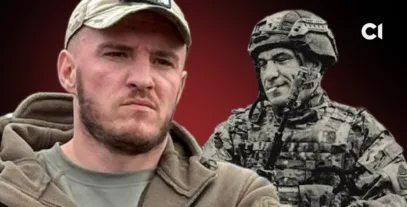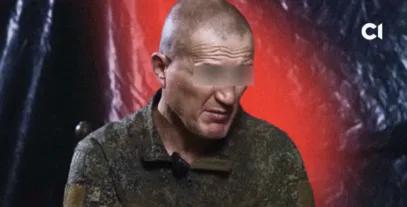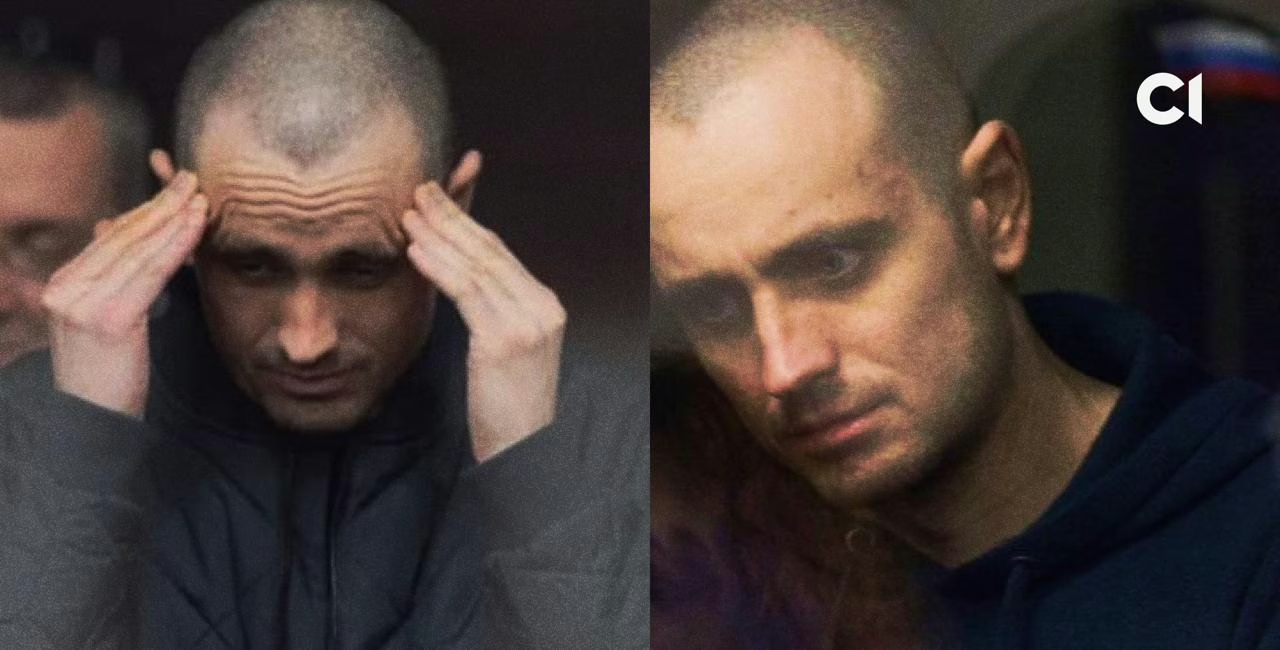
Former Anti-Terrorist Operation participant Serhiy Kovalskyi has been sentenced in Russia to 17 years in prison. In 2022, Russians detained him and nine other Ukrainian civilians in occupied Kherson on charges of alleged involvement in a terrorist organization.
“You have the right to hold me as your enemy, under the Geneva Conventions, but to judge me for trying to defend my homeland? I believe you do not.” These were Serhiy Kovalskyi’s final words before his sentence was announced, Slidstvo.Info reports.
Serhiy Kovalskyi has a military education. In 2015–2016, he took part in the Anti-Terrorist Operation, but in the years immediately preceding the full-scale invasion, he worked in farming and was not involved in military service.

According to his mother, Iryna, after the start of the full-scale war, her son remained in occupied Kherson: “In the first days of the occupation, he, of course, prepared to return to his military unit, but received orders to stay in occupied Kherson and carry out the combat tasks assigned to him.”
On August 3, 2022, Russians took Serhiy prisoner. At first, the man was held in a basement on Luteranska Street in Kherson, where he was brutally tortured.
“He was one solid bruise—from his neck to his waist. He was a blue man. All he said was, ‘Electricity,’ and I understood everything,” Serhiy Kovalskyi’s wife, Oleksandra, told Slidstvo.Info in late 2022.
“Cell meant for four people, with 22 of them in there”
According to Iryna Kovalska, shortly before the liberation of Kherson, Serhiy and nine other Ukrainians were taken to occupied Crimea. One of the men did not survive the torture and died, and the rest were later called the “Kherson Nine.”
“They (the ‘Kherson Nine,’ — ed.) stayed in Crimea for a very short time. According to my information, three or four days, because that was exactly when the Crimean bridge was blown up for the first time, and they could not be taken out,” said Iryna, Serhiy Kovalskyi’s mother. “Then the men were transferred to Lefortovo.”
Lefortovo Pre-Trial Detention Center is a pre-trial detention facility in Moscow that is effectively subordinate to Russia’s FSB Federal Security Service. It holds suspects or defendants accused of committing serious and especially serious crimes. This detention center is considered one of the most closed facilities in Russia.
According to Iryna, in Lefortovo, Serhiy waited more than a year for the pre-trial investigation to end.
“When I first received a letter from Serhiy, I scrutinized every word, every period, the order of words in the sentences… I read into everything to learn at least something about my son,” Iryna said.
After the case was transferred to court, Serhiy was moved to Pre-Trial Detention Center No. 1 in Rostov-on-Don.
“Their cell [in Pre-Trial Detention Center No. 1] was meant for four people, but there were 22 of them in there. Can you imagine? They couldn’t even squat. So you just stand there like a post. Serhiy joked that the day passed in a fun way: you stand all day long. There’s a line to brush your teeth, a line to use the toilet, you sleep a little, wake up, and then you’re back in line,” Iryna said.
According to her, the hardest time was in summer: “Such stuffiness. Sometimes it was completely unbearable. Thank God, those guards opened the ‘feeding hatch,’ and the guys took turns sticking their heads in there and breathing for five minutes. And so on in a circle.”
According to Iryna, the guys were in the cell constantly: “No walks at all, no fresh air. And with that many people… They crowded in there, took turns sleeping: two to three hours each.”
“I look at the letter: the first three sentences are there, then everything is crossed out”
Iryna Kovalska said that letters from her son were inspected by Russian overseers, so sometimes she received only fragments of the text.
“Sometimes I’d look at a letter: the first three sentences were there, and then everything else was crossed out so thickly you couldn’t read it. Sometimes the first page was there, the second was missing, and the third was there. It’s normal for them: if I want to, I’ll let it through; if I don’t, I won’t,” she said.
Iryna also added that neither she nor her son can write about the war or the situation in the country: “You write about butterflies, little flowers… If you’re alive, that’s already good.”
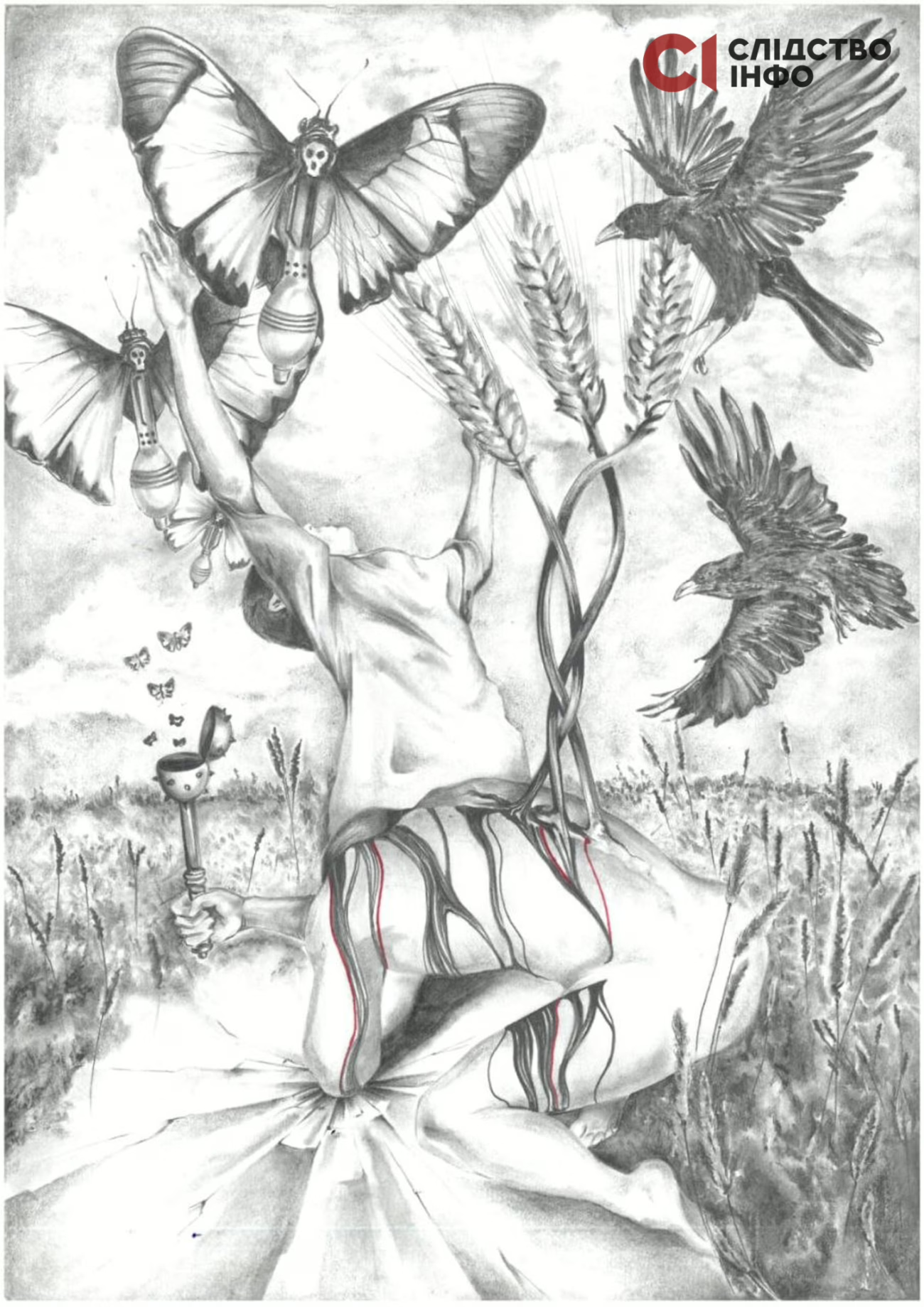
Besides letters, Serhiy sends his mother drawings and poems: “Serhiyko was always a very skilled graphic artist, even before the war.”
Iryna printed digital copies of her son’s drawings on photo paper and organized a small exhibition in Kherson. Serhiy drew one of the works in a Kherson basement on a cardboard box; others had already been made at the Lefortovo Pre-Trial Detention Center and the Pre-Trial Detention Center No. 1 in Rostov-on-Don.




“Strength lies in truth, and truth comes with hardship and restrictions”
On January 30, 2026, the final court hearing took place in the case of the “Kherson Nine.” The Southern District Military Court in Rostov-on-Don announced sentences for the Ukrainians: from 14 to 20 years in prison.
Serhiy Kovalskyi was found guilty under three articles of the Criminal Code of the Russian Federation: attempted crime, act of international terrorism, and organization of a terrorist group. He was sentenced to 17 years in prison, with the first five years to be served in prison and the rest of the term in a strict-regime penal colony.
Russia’s FSB accuses the “Kherson Nine” of allegedly plotting to eliminate occupation officials, as well as manufacturing and planting explosive devices on orders from Ukraine’s Security Service (SBU).
The majority of the men convicted in this case are civilians. However, according to his mother, Iryna, Serhiy Kovalskyi repeatedly stated in court that he is a serviceman. He emphasized that Russia has no right to judge him for trying to defend his Homeland.
“I am a serviceman of Ukraine. I resisted the armed invasion, which the Russian authorities refer to as a ‘special military operation.’ The Criminal Code of the Russian Federation does not allow Russian courts to consider ‘crimes’ committed on the territory of a foreign state against non-Russians. The reality is that you have the opportunity to judge me, but in my view, you have the opportunity—yet no real right to do so. You have the right to hold me as your enemy, under the Geneva Conventions, but to judge me for trying to defend my homeland? I believe you do not. Perhaps this statement of mine will prompt the court to add a few more charges. But as the saying goes, strength lies in truth, and truth comes with hardship and restrictions. And I accept this as another trial. Glory to Ukraine!”
These were Serhiy Kovalskyi’s final words before his sentence was announced, as read to Slidstvo.Info by his mother, Iryna.

According to Doctor of Political Science and expert at the Center for Civil Liberties Mykhailo Savva, Russian authorities essentially do not distinguish between the status of Ukrainian prisoners of war and civilians detained for resisting the occupation.
“This situation has arisen because for them (the Russians — ed.) it is not a war, but a ‘special military operation.’ The Russian regime very crudely violates the Geneva Conventions and does not separate these statuses,” Savva noted.
He also stresses that after the annexation of Ukrainian territories, Russia extends its own legislation and judicial system to Ukrainian citizens, which directly contradicts international humanitarian law.
“The Geneva Conventions say that in occupied territory, the occupier cannot introduce its own legislation. It must use the local one. But they have declared annexation. And therefore, from the point of view of the Russian regime, they have no obstacles,” the expert says.
“There is no such thing as civilian prisoners”
Mykhailo Savva explains that in international law, there is no concept of a “civilian prisoner.”
Military personnel (combatants) can have the status of prisoners of war, while civilians (non-combatants), in case of unlawful detention, are considered hostages or illegally held persons.
According to the expert, returning civilian citizens is a much more complicated process than exchanging prisoners of war.
“Far more prisoners of war have been returned than civilians. Ukrainian prisoners of war can be exchanged for Russian prisoners of war. But there is no one to exchange Ukrainian civilians for, except collaborators,” Savva said.
According to him, over two years under the state project “I Want to Go Home,” 70 citizens have been returned to Ukraine.
The project was created to exchange collaborators and state traitors convicted in Ukraine for Ukrainian prisoners of war and civilian hostages held by the Russian Federation. It was launched in July 2024.
According to the head of the Secretariat of the Coordination Headquarters for the Treatment of Prisoners of War, Bohdan Okhrimenko, more than a thousand Ukrainians have been in Russian captivity since 2022. Since the beginning of the full-scale war, as of the beginning of May, 9,048 of our people have been returned.