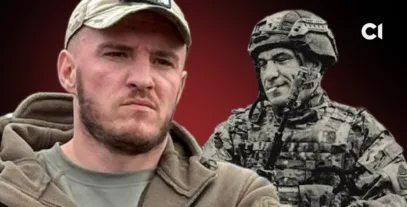
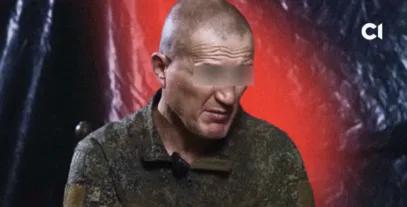
Yevheniy Sholudko is 28 years old. A native of Sumy Oblast, he joined the military in July 2023 and became a border guard. In less than six months, Yevheniy was captured in the border area while moving toward a position with other soldiers.
In captivity, Yevheniy lost 30 kilograms and returned home with a massive scar—during one of the “initiations,” a piece of his skin was ripped out. “I was running around, reviving the guys, saving them. Then I would lead them into the office and hold them while they were photographed,” Yevheniy recalls of the so-called initiation at one of the Russian penal colonies.
On July 23, 2025, Yevheniy Sholudko was returned to Ukraine as part of an exchange. He shared the story of his time in Russian captivity with Slidstvo.Info.
«ПРО ПОЛОН УЗАГАЛІ НЕ ДУМАВ»
Yevheniy Sholudko lives in Sumy after he moved here with his wife during the full-scale war. At the beginning of the invasion, the man survived the occupation in a village in the Konotop district, where he had gone to visit his parents: “They (the Russians — ed.) stood in the villages and shot at everything in sight.”
On July 27, 2023, Yevheniy Sholudko signed a contract and became a serviceman of the State Border Guard Service. He served in the Krasnopillia municipality of Sumy Oblast.
“There was constant shelling there. I did not think about captivity at all. I thought I would just end up ‘killed in action’, and that would be it,” Yevheniy says.
Yevheniy fell into Russian captivity on December 9, 2023.
“We were heading to a position; there were about six of us. On December 8, we were told that a sabotage and reconnaissance group had entered. Fire was opened, and they disappeared somewhere. We were walking through a field, a forest, a ravine, and we stopped to wait for the others (my friend Illya and I were ahead, and they were behind). And suddenly, from the woods we hear: ‘Drop your weapons and surrender,'” Yevheniy recalls.
The Russians led the captured border guards to the Russian village of Popovka.

“I WAS RUNNING AROUND REVIVING THE GUYS. THEY WERE SH*TTING THEMSELVES FROM THE PAIN”
On May 25, 2024, Yevheniy was taken to a penal colony in Kamensk-Shakhtinsky in Russia’s Rostov Oblast. There, the Ukrainian prisoners were forced to undergo a brutal so-called “initiation.” They were beaten until they lost consciousness, and the skin was ripped from their backs. As a result, Yevheniy is left with a large scar.
“I have a scar across my entire back. They [the Russians] had this thing with balls on it. When they swing it, those balls spread apart. And when the iron rod is raised, it rips the skin off. I have a foolish habit of helping, and so, like Mother Teresa, I was running around reviving the guys. Completely naked. People were losing consciousness there, and I was saving them, lifting them up, and leading them into the office so they could be photographed,” Yevheniy says.
He knows that not everyone could survive such “initiations” in Kamensk-Shakhtinsky. Specifically, a jailer named Nikita tortured people to death.
“He is a former fighter; his moves are practiced. He kicked me twice so hard that I could barely stand up afterward. This Nikita beat a guy to death—he crushed his internal organs. It got to the point where the guys, to put it bluntly, were sh*tting themselves from the pain,” Yevheniy Sholudko says.
In the Kamensk-Shakhtinsky colony, the prisoners had to march to the canteen “with a song.” They were forced to sing Soviet and Russian songs, such as Katyusha, Victory Day, and songs by the band Lyube.
“Before this, the guys told us the canteen was an ordeal. The spec-ops guys would run in and beat you as you go. They were killing people,” says the former prisoner.
If you’d like to see more exposés of Russian crimes on our website, please support our work with a one-time donation or a monthly contribution. You can also sign up for a monthly donation on Monobase!
ABUSE IN THE KIZEL PRETRIAL DETENTION CENTER
On September 12, 2024, Yevheniy was transferred to Pretrial Detention Center No. 3 in Kizel, in Russia’s Perm Krai. This is the detention facility in the Urals where journalist Viktoria Roshchyna and the Mayor of Dniprorudne, Yevheniy Matveiev, died. Slidstvo.Info also established that the kidnapped Melitopol journalist Anastasia Hlukhovska is being held in Kizel.
Yevheniy Sholudko says that in the Kizel remand prison, they had to stand under video surveillance throughout the entire day. Due to this regime, the prisoners’ legs would swell.
“A camera watches us, and a speaker hangs there, through which they give commands. You are not allowed to talk. You just stand there, head down, hands behind your back. Just turning around is a sign that you are talking. Once, we got caught talking. They took our entire cell out and asked who was talking. Everyone was silent, but three of us said we were speaking. The guys do squats, and they beat us,” Yevheniy recalls.
During his 10 months in the Kizel prison, Yevheniy Sholudko lost 29 kilograms. Since the captives were forbidden to speak to one another, they mentally counted every day in captivity: “I even counted how many houses were in my village where my parents live, and how many people were there.”

In Kizel, the jailers set up a separate room for abusing Ukrainian prisoners—the so-called “rubber room.” They could be sent there for the slightest violations of the regime. For example, for a refusal to sing the Russian national anthem: “It is a room made entirely of rubber. No windows, nothing. Just rubber walls; there is no sink, no toilet, nothing. And you are naked there. Completely naked; they strip you. And you just stand in that cell. If you need to go to the bathroom—you go to the corner. The guys were screaming there; they locked them up one by one. At night, one boy also screamed: ‘Please, let me out, I am cold, I feel sick.’ They would open the door, beat him, tell him to ‘Shut your mouth!’ and that was it.”
The prisoners also had to memorize Russian poems and then recite them to the guards during inspections. If someone stumbled, they were punished with a beating.
“The most interesting part was when some commission arrived. Suddenly, everything became perfect. You could talk, read a book, and go to the toilet without a command. They issued new socks. They took a boy from our cell, gave him a bag (he said it had candy, cigarettes, and various clothes), filmed a video of him receiving it and saying ‘thank you to the Russian Federation,’ then took the bag from him and put him back in the cell,” Yevheniy recalls.

“THEY THOUGHT WE WOULD FATTEN UP IF WE STARTED EATING OIL”
Yevheniy Sholudko adds that it was difficult to hold on mentally because of the lack of news from home, as the letters his wife wrote him never reached the Russian prisons. However, one day, Yevheniy’s cellmate was brought a single letter, which the entire cell read together: “There were drawings in it; we looked at them. His young daughters had drawn their mom and dad standing together. I even shed a tear; it was so touching. We [shared a cell] with him for a month, and I looked at those drawings about 15 times.”
Yevheniy recalls the period when the Russian guards began “preparing” him for the exchange—they brought porridge swimming in oil so he would gain weight, and they stopped the beatings to ensure there were no bruises or wounds.
“They thought we would fatten up if we started eating oil,” he says.
On July 23, 2025, Yevheniy Sholudko was returned to Ukraine as part of a prisoner exchange.
“I get off the plane and see—Gomel (a city in Belarus — ed.). At that point, I was done… There were bags of food in the bus. I open them, and there are wafers, sweets, and Belarusian Coca-Cola. My friend Illyukha foolishly ate two cans of stewed meat and had to go from Chernihiv to Kyiv in an ambulance. That is to say, we gorged ourselves out of foolishness,” says the released Yevheniy Sholudko, laughing.
His family—his mother, father, sister, and wife—traveled to Chernihiv, where Yevheniy and the others were brought. He looked so emaciated that his relatives only recognized him by the shape of his eyebrows.

For several months after his return, due to the constant hunger in captivity, Yevheniy could not regain a sense of fullness: “At first, I could not stop eating; I was constantly hungry. My roommates and I did not sleep at night; we ate. Only a few weeks ago did I finally feel that I was full.”