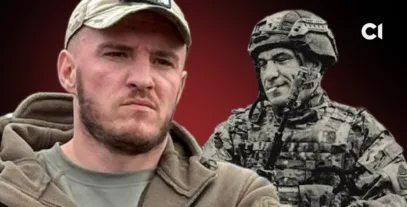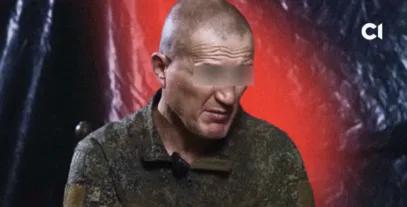
“I think I will get exchanged anyway,” says Russian soldier Vladimir Ivanov, whom a Kyiv court sentenced to life in prison. In January 2025, Ivanov gunned down two Ukrainian fighters who had surrendered. The events unfolded in Russia’s Kursk Oblast.
Slidstvo.Info managed to gain access to the pretrial detention center where the Russian serving a life sentence is being held and recorded an interview with him. In addition, the journalists obtained video recordings of witness interrogations in the case, drone footage, and spoke with the ex-wife of one of the executed Ukrainians as part of Slidstvo.Info’s investigation.
“MOTIVATION IS TO DEFEND MY MOTHERLAND”
Kyiv pretrial detention center. From one of the cells marked “For holding prisoners of war,” staff escort out 54-year-old Vladimir Ivanov. Ivanov is wearing a black fleece sweatshirt and jeans saturated with cigarette smoke.

Vladimir Ivanov is being held in pretrial detention rather than a prisoner-of-war camp because on January 9, 2025, he shot two unarmed territorial defense fighters who had surrendered — Viktor Liapota and Ivan Kondratiuk. That same day, Special Operations Forces soldiers captured Vladimir Ivanov and two of his comrades.


Ivanov sits down at the table and, when asked to tell more about himself, answers laconically: “Citizen of the Russian Federation, born in Sevastopol.” From Crimea, Ivanov and his mother moved to Russia’s Chelyabinsk Oblast when he was 10. He finished school and completed his mandatory military service in Chita. Ivanov is married and has two daughters.
Ivanov returned to Sevastopol, where he was born, after more than 40 years. He was sent to the city for two weeks of training after he went to the military enlistment office in 2024 and signed a one-year contract.

“I volunteered. I asked to join the Marines. And they sent me to the Marines,” Vladimir Ivanov says. He adds that the desire to volunteer for the war against Ukraine arose when he learned about the Kursk operation. He ended up in the 40th Separate Marine Brigade of the Russian Federation.
“You should understand yourselves that Kursk Oblast is Russian territory. My motivation is to defend my motherland. I’m the kind of person who believes that if something is mine, it must be defended,” the Russian declares.
When asked if he ever considered that after years of active combat in Ukraine, the war might spill over into Russian territory, he boldly replies: “It came, and it went.”
In December 2024, Vladimir Ivanov was sent to fight in Kursk Oblast. After the New Year, the Russian found himself near the village of Guyevo in the Sudzha district: “We arrived in the forest and dug in.”
On January 9, 2025, a group of Russian soldiers spotted two Ukrainian territorial defense fighters — Viktor Liapota and Ivan Kondratiuk — who were heading to their positions but walked into an ambush. Their brother-in-arms, Oleksandr Klymchuk, explains: if they had known there were Russians in that area, Liapota and Kondratiuk would not have gone there alone.

“There’s a gray zone where there’s no clear line between our side and theirs. In one trench, there could be our guys, and just two meters away in another trench, theirs might be sitting. Of course, they (Liapota and Kondratiuk) were in the gray zone, which means they were armed no matter what. You don’t go out there for a stroll,” says Oleksandr.
“GAVE THE ORDER TO OPEN FIRE, YELLING INTO THE RADIO”
At the same time, Russian soldier Vladimir Ivanov, during the interview, first claimed he could not recall whether the Ukrainian soldiers had weapons with them, and later began categorically denying that fact.
“There were no weapons. They were going to pick up a package from a drone,” Ivanov declared.
Viktor Liapota and Ivan Kondratiuk were stopped by a Russian soldier with the call sign “Lebed.” Meanwhile, his comrade, Yevgeny Lantsov, contacted the commander via radio. The commander’s call sign is “Ryazan”; the identity of this Russian soldier has not yet been established.

“I reported to Ryazan that there were two Ukrainian soldiers here and that they posed no threat. Ryazan gave the order to open fire. And he shouted it, very loudly. He was just yelling into the radio. Apparently, the Ukrainian prisoners of war heard it and started to run,” Lantsov testified during interrogation.
Vladimir Ivanov also confirms that the captured territorial defense fighters began moving in different directions. Then the Russians opened fire.
Vladimir Ivanov: Shots rang out.
Journalist: And who was shooting?
V.I.: I was. (laughs — ed.)
J.: What were you shooting with?
V.I.: With a machine gun. AK-47.
J.: How many people in total were shooting, can you say?
V.I.: Two of us.
J.: With whom?
V.I.: Should I give the call sign?
J.: Give the call sign.
V.I.: “Lebed.”
J.: And what happened to Lebed?
V.I.: He is dead.
The Ukrainians Viktor Liapota and Ivan Kondratiuk fell. The Russians reported to the commander that they had “liquidated” the prisoners.


“When the shooting stopped, I climbed out to look. On the left stood ‘Yary’ (Vladimir Ivanov’s call sign — ed.), changing his magazine, reloading his weapon,” soldier Dmitry Kondratyev, who witnessed the crime, said during interrogation.

Prosecutor from the Office of the Prosecutor General Taras Semkiv told Slidstvo.Info: “They (Liapota and Kondratiuk — ed.) unconditionally laid down their weapons, were completely under the control of the enemy and, according to the Geneva Conventions, had the status of prisoners of war from that moment. The pretrial investigation regarding the commander is still ongoing.”
“KILLED ONE, THEN THE SECOND, THEN THE THIRD”
Vladimir Ivanov says that 10 to 15 minutes after the extrajudicial execution of the Ukrainians, the Russians came under heavy fire. In particular, three Ukrainian FPV drones eliminated three of his comrades. Among them was Lebed, who, together with Ivanov, had shot the unarmed territorial defense fighters.
“And Baba Yaga (a drone — ed.) flew in on us, smashing all the dugouts. We could not stick our heads out, could not climb out. They killed one, then the second, then the third. FPV [drone] after FPV. I heard the guys falling, screaming. It was all instantaneous. Explosion, scream, and silence,” Vladimir Ivanov says.
About an hour later, Special Operations Forces soldiers entered the Russian positions and captured Ivanov and two other soldiers. The bodies of the executed Viktor Liapota and Ivan Kondratiuk could not be evacuated — one of the Ukrainian defenders, whose name is not disclosed for security reasons, testified in court that the Russians had mined them.

“We sent up a drone and looked at the area where the shootout had taken place. And it was recorded that two bodies were lying there. The position of the bodies was face down, on their stomachs. The distance between them was about 15 meters. After the murder was committed, our SOF fighters entered the area. And they discovered that the bodies were mined. At the same time, we could not evacuate the bodies,” the serviceman said.
Liapota and Kondratiuk’s brother-in-arms, lawyer Oleksandr Klymchuk, notes that afterwards the fighters approached the bodies again to take biological samples. However, unsuccessfully.
“The problem of war is that evidence will remain lost under the rubble underground. Because how do you document it? For example, an ordinary soldier goes out to that position — how does he collect samples? Without forensic experts, without the proper kits. It has to be done correctly. You cannot bring a specialist there, and an ordinary soldier, even if you train him, even if he does it, given all the circumstances I mentioned earlier, the procedure itself is still called into question. Because it is not provided for by law or the Criminal Procedure Code,” Oleksandr Klymchuk explains.
“I CANNOT BRING EASTER BREAD TO THE GRAVE. THE CHILD CRIES ALL THE TIME”
The men executed by the Russians, Viktor Liapota and Ivan Kondratiuk, served in the 241st Territorial Defense Brigade. The 49-year-old Viktor is survived by a 14-year-old son, while the 39-year-old Ivan left a brother and parents.

Both executed men still have the status of missing in action, but Liapota’s family is now trying to confirm his death through the courts.
“Easter is coming, and I baked Easter bread. And I cannot bring him Easter bread to the grave. No cross, no grave. The child cries all the time. What kind of grave is it when the body was not brought back? What is he lying there in… a field. What is left of him now… The second year. And he was so small, skinny,” says Viktor Liapota’s ex-wife, Nataliya.

Viktor had served in the 241st Territorial Defense Brigade since 2023. Nataliya says he could have avoided service because she has a disability. But he decided he would not hide, so that their son “would not be spat in the face.” In Kursk Oblast, Viktor Liapota was wounded in the leg, underwent treatment, and was able to spend 12 days at home with his son Marko.
“He never left Marko’s side. He was so kind. There are few people like that. He would give his last money… Even if there was no money, he would walk home from work, stop by the store, put it on his paycheck, and bring the child some gingerbread or candy. Marko would say: ‘Mom, those gingerbreads of mine are already moldy, but Dad kept bringing them.’ Marko was born when we were almost 37 years old; I could barely carry the child. He cried with joy that a son was born at this age,” Nataliya Liapota recalls with tears in her eyes.
She expresses hope that the man sentenced to life in prison, Vladimir Ivanov, can be exchanged for Ukrainians imprisoned by the Russians.
“I will not bring Vitia back by having him [Ivanov] sit here and stuff his face. They feed them like royalty in there. Meanwhile, our boys are out there starving,” Nataliya says.
Vladimir Ivanov himself doesn’t believe he’ll spend the rest of his life in prison in Ukraine. “I think I will get exchanged anyway,” he says.

At the same time, Prosecutor Taras Semkiv notes that so far, Ukraine has not handed over Russians convicted of serious crimes for exchange. This concerns murders, violence, and torture.
“But, again, the issue of exchanges is quite sensitive, because as a result of such exchanges, Ukrainian defenders whom we are all waiting for here return to Ukraine,” Semkiv adds.
The Office of the Prosecutor General told Slidstvo.Info that in Russia’s Kursk Oblast, the Russians have shot at least 75 unarmed Ukrainian prisoners. In total, 306 executed prisoners on the battlefield have been documented since the beginning of the full-scale invasion. As a result of these investigations, Ukrainian law enforcement has charged nine Russian soldiers. Prosecutors have sent indictments to court in seven cases, and five defendants have already received verdicts.