During 2023-2024, the Russian company Nika dispatched over 54,000 tons of wheat from the devastated, occupied Ukrainian city of Mariupol to Turkey. A portion of these agricultural products ended up with Erisler—a Turkish entity with a 100-year history that participates in the United Nations World Food Programme. The owners of the Russian shipping company maintain other business interests as well: they produce drones utilized in the war against Ukraine.
“Turkey will not allow illegal trade in Ukrainian grain”
“Turkey is examining information regarding the country of manufacture and the port of departure. Each time, we verify and confirm that the products are manufactured in Russia. Turkey will not allow the illegal trade of Ukrainian grain or any other products by any country, including Russia. We will also not accept these goods ourselves. The determined position of Turkey and its state bodies on this issue remains unchanged,” declared then-Turkish Foreign Minister Mevlüt Çavuşoğlu during a joint press conference with his British counterpart.

These words, delivered four months after the start of Russia’s full-scale invasion of Ukraine, were a reaction to a statement by the Ambassador of Ukraine to Turkey, Vasyl Bodnar. The Ukrainian diplomat reported that Russia was exporting stolen Ukrainian grain to Turkey. At that time, in June 2022, Bodnar stated that Ukrainian grain was being shipped from the Crimean Peninsula, which Russia seized in the spring of 2014.
However, it turns out that the problem of exporting grain from occupied Ukrainian territories to Turkey would not only remain unresolved but would expand its geography. Grain would be exported not only through Crimea but also from the port of Mariupol, which was occupied in May 2022.
Family business
There was virtually no mention of Russian businessman Roman Gurov in the media until July 2023. At that time, Russian media reported that a drone manufacturing plant was planned to be built in Rostov Oblast. Roman Gurov, the CEO of Roboavia, signed a corresponding agreement with the region’s deputy governor.

According to Ukraine’s Defense Intelligence, Roboavia manufactures the Sarych reconnaissance drone and the Surprise strike drone. Since 2024, the enterprise has been under sanctions by the United States and Ukraine.

Gurov is engaged in drone production alongside his 75-year-old mother, Lyudmila Gurova. She is the owner of Roboavia, and he is the director. Valentyna Samar, head of the Ukrainian Center for Investigative Journalism, who researched the company’s activities, suggests that Roman and Lyudmila are not the actual owners of Roboavia. “We consider them nominees for the reason that the Gurovs never previously had any systemic business related to the production of UAVs,” says Valentyna.

In addition to Roboavia, Roman Gurov and his mother operate another family business. Since 2022, Lyudmila has managed the Russian company Nika, which is owned by her son. The firm’s profile indicates that it trades in grain, seeds, and feed.
Slidstvo.Info journalists established that virtually all the agricultural products that Nika exports come from Russian-occupied Mariupol.
From occupied Mariupol to Turkey
According to a source in the Russian customs service, in 2023, the Nika company exported wheat worth $3.7 million (15.5 thousand tons) to Turkey and Egypt. The following year, the volume of exported wheat increased nearly fourfold—to 59.5 thousand tons, valued at $12.9 million.
In all product conformity declarations (documents confirming that a product meets established technical requirements and standards) journalists found for Nika’s wheat for the period from July 2022 to early 2026, it is stated that its production sites are located in occupied Mariupol.

According to Russian customs, the company receiving the grain sent to Turkey is Global Commodities and Logistics Limited.
However, this firm is not the final recipient of the wheat in all cases. Slidstvo.Info journalists obtained a sea manifest (a customs control document) for one of Nika LLC’s shipments in April 2024.

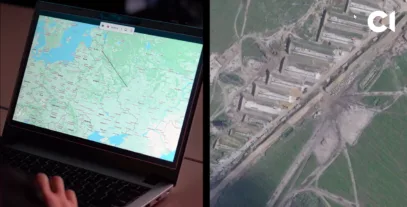
The document indicates that the Russian vessel Alfa M (which has been under Ukrainian sanctions since November 2023) dispatched 7,857 tons of wheat to the Russian port of Temryuk in Krasnodar Krai, on the coast of the Sea of Azov. From there, according to Russian customs data, the goods were shipped to Turkey. In a cargo declaration dated April 6, 2024, it is stated that the cargo left Mariupol, which was referred to not as a Ukrainian city, but as a Russian one. According to the manifest, the Russian company Nika sent this grain batch on behalf of Global Commodities to the Turkish company Erisler Gida Sanayi Ve Ticaret A.S.

“The removal of grain from occupied ports occurs in violation of the state border of Ukraine; proper documents are not processed, customs payments are not paid, and the vessel does not receive permission from Ukrainian state services. The batch of wheat removed by the vessel Alfa M from occupied Mariupol effectively has the status of contraband. After loading in Mariupol, the vessel enters the Russian port of Temryuk, where it processes Russian documents for the batch of stolen grain, the true origin of which is hidden. Such systemic disinformation activity, occurring in the Russian Federation at the state level, undermines the foundations of economic security for participants in international trade,” says Kateryna Yaresko, a journalist for the Ukrainian investigative center Myrotvorets’s SeaKrime project.
Journalists obtained information about the quality testing of this specific grain batch. An employee of the Ukrainian representative office of the international company Cotecna (headquartered in Switzerland), speaking on condition of anonymity, reported that the wheat testing was conducted in Odesa, Ukraine. To confirm these words, the informant sent Slidstvo.Info a photo of the sample that was processed in the Ukrainian laboratory; the volume of the batch matches to the kilogram: 7,857 tons.

Judging by the markings, the sample arrived not from Mariupol, but already from Turkey. The country of origin is listed as Russia, dated April 19, 2024.
Grain from occupied territory, noodles to free territory
The Turkish company Erisler, which received a grain shipment from Mariupol in April 2024, primarily produces flour. The company’s website states that they own “4 mills with a total production capacity of 2,300 tons/day and 850,000 tons per year, making Eris flour mills one of the main producers of wheat flour in the country.” It also states: “We at Eris believe that food business is a business of conscience.”
In 2013, the company began producing a new product—instant noodles—which, of course, contains wheat flour. The noodles are also sold in Ukraine. The proportion of flour that returned to Ukraine from the occupied territory as part of this product remains unknown.

Expropriation and nationalization
According to Valentyna Samar, after the Russian occupation of territories in 2022 and the sham referendum, life became difficult for Ukrainian farmers who did not leave: “Everyone was forced to register with the civil-military administrations. These actions had no legal significance. All control over assets fell to the occupation administrations, which could do whatever they pleased with them. Expropriation under the guise of nationalization occurred either because people were helping the Armed Forces of Ukraine – and there were many such individuals.”
Reuters reported that the volume of grain stolen by Moscow between 2022 and August 2025 totals 15 million tons. During 2025, according to the deputy head of the Foreign Intelligence Service of Ukraine, it was more than 2 million tons.
Journalists reached out for comment to the companies Nika, Erisler, Global Commodities, and the central office of Cotecna.

In its letter, Global Commodities states that it “operates in the Azov-Black Sea region in strict compliance with internationally recognized trading standards,” denies purchasing grain from Mariupol, and “reserves all rights to pursue legal remedies without further notice.”

The response from Cotecna’s Geneva office stated: “Cotecna categorically denies any allegation that it performed services in connection with agricultural goods exported from non-government-controlled areas of Ukraine, including Mariupol. With respect to that particular cargo, Cotecna has no independent means to verify your assertions regarding the origin of goods beyond the documentation presented by its contracting counterparty, which did not mention Mariupol.”
This investigation was prepared in cooperation with the Organized Crime and Corruption Reporting Project (OCCRP).