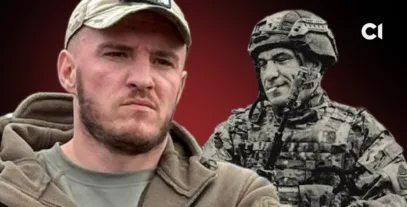
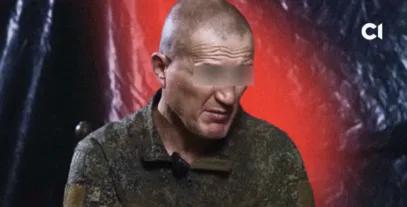
Mariupol native Yaroslav Rumyantsev has served since 2016. During the defense of his home city in May 2022, he surrendered to captivity following a presidential order, where he remained for 39 months. “They beat you, choke you, spray you with gas, drown you in a bathtub,” Rumyantsev says, recalling various types of torture in captivity.
This year, on Independence Day, he was returned to Ukraine. “[Along the road] people are standing with flags, and they are welcoming us home. We are in tears; we are shaking. I never could have thought that we would be met like this,” Rumyantsev recalls of the day of the exchange.
More about his journey in Slidstvo.Info’s interview.
WAR IN MARIUPOL AND SURRENDER
Yaroslav Rumyantsev is a serviceman of the 23rd Marine Detachment and had lived in Mariupol his entire life. He became a sailor in 2016 after signing a contract. He performed assignments in Mariupol, Berdyansk, and Shyrokyne.

Yaroslav was in his hometown of Mariupol when the full-scale war broke out.
“In the first days, we stayed at the headquarters; that is, our headquarters was located on Chervonoflotska Street. This is the exit from Mariupol toward Manhush (a village in Donetsk Oblast — ed.). That is to say, we were defending one of the most important flanks,” Yaroslav says.

Yaroslav and his brothers-in-arms went into Russian captivity on May 16, 2022, from the Azovstal plant. A commander came to the fighters, among whom was Yaroslav, and said that they were surrendering by order of the president: “Perhaps the Russians would have buried us there, because there was no way out of the city. But still, they did not take us by force.”
He recalls that the Russian soldiers were very joyful when they saw the exhausted and dirty Ukrainian defenders.
“And there they stand — new uniforms, new weapons. That is, these people had not fought against us. These were just people who arrived for the cameras. To show that they are such tough guys with big machine guns and cool assault rifles taking Azovstal into captivity,” Yaroslav Rumyantsev says.
Initially, the prisoners were taken to Olenivka, but within a few days, Yaroslav found himself in the Taganrog pretrial detention center. Yaroslav calls the journey to this prison the “first stage of torture.”
“It was a very uncomfortable little ride. Five Kamaz trucks. 50 people in each truck. A person sits down. Legs and arms are tied, and eyes are blindfolded. Arms are thrown over another person. That is, a person sits in front of me, and I lean my back against another person. And we sit in the Kamaz like this. There is nothing to breathe; there is no air at all,” Yaroslav Rumyantsev recalls.
Upon arrival, the man was thrown from the vehicle by his clothes and ordered to run through a “gauntlet” of special forces and detention center employees.
“I am walking, and they are hitting me in the face, legs, and arms with rubber truncheons and tasers. There were about 50 people receiving us. And these were people in very good physical condition. They were under the influence of alcohol and very fierce. And then I hear screams. These are adult men screaming… It is impossible to forget,” Yaroslav says.

The wake-up call at the Taganrog pretrial detention center was at 6:00 a.m. But due to stress and fear of the morning inspection, many prisoners woke up earlier: “Because you start to feel afraid as soon as the sun rises.”
For breakfast, the prisoners were supposed to receive milk porridge, bread, and tea. But according to Yaroslav, the porridge was unsalted, made with water, and often undercooked.
“There was almost no bread, and when there was, you could see right through it; it was so thin. Instead of tea, it was just diluted water. Then a prosecutor comes and says, ‘Well, was the borsch today with meat? Is everything fine? Did you eat?’ This is mockery. They know how we eat; why do they ask us? But if you answer in any way that is not to their liking, the next morning or that very evening, some guys will come and explain to you that you were wrong,” the former prisoner recounts.
“THE ENTIRE FLOOR WAS COVERED IN BLOOD”
After the morning meal, an inspection awaited the captives, which was mostly accompanied by beatings. Then they waited to be called for interrogation.
“They take you for interrogation; the guys scream very loudly, and you can hear them being beaten behind the cell, on the second floor, and elsewhere. That is, any exit from the cell is a stress because you know you will be beaten or tortured in some way. I will speak for everyone who has been in captivity since 2022: they beat you, they choke you, they use electric shocks, they burn you, they spray you with gas, they put a bag over your head, they drown you in a bathtub or a bucket or a basin, and they fire a gun near your ear,” Yaroslav Rumyantsev says.

He also recalls a situation where special forces used cigarette butts to burn out the names of a prisoner’s wife and two children, which were tattooed near his heart.
After four months in Taganrog, Yaroslav was transferred to Correctional Colony No. 12 in Kamensk-Shakhtinsky, in Russia’s Rostov Oblast. He spent two years there.
The so-called “initiation” in Kamensk-Shakhtinsky was extremely brutal: “I am 2 meters tall, and they hit me mid-jump. How can a person withstand it when this rubber baton cracks and shatters into pieces? Can you imagine the force required to strike? And when a person looks like something out of a horror film with like a pictogram painted across their back in streaks of blood. Smashed heads… the entire floor was soaked in blood.”
To clean up the aftermath of the beatings, the colony employees brought the prisoners their clothes and ordered them to clean everything up, using the clothing as rags.
In this prison, the Russians took special pleasure in torturing Ukrainians and devised various methods of abuse.
“Ten of us stand up, holding hands. A Russian hits one with a taser and watches how many people the current passes through. Why? Just because they want to. Another situation: wires are sticking out of the wall. They tell a guy, ‘Grab it.’ He says, ‘But the current will hit me.’ They strike him on the back with a baton: ‘Grab it!’ He grabs it, it hits him, and he falls. ‘Grab it again!’ And he keeps grabbing it like that until he passes out.”
The last place of detention during Yaroslav Rumyantsev’s time in captivity was the pretrial detention center in Glazov (Udmurt Republic). And the jailers’ treatment there was noticeably different.
“Completely different people there. Almost all of them couldn’t care less about us. And they say, ‘Guys, we wish we could send you home right now. We are just waiting for the order.’ Better food, better treatment,” Yaroslav says.
In this pretrial detention center, he received a letter from his relatives for the first time: “My hands are shaking; I cannot open it or read it because tears are flowing. I realize that they (the relatives — ed.) are alive, just alive, and that is it.”
Yaroslav Rumyantsev adds that due to constant pressure, propaganda and the exhaustion of enduring inhuman torture, some Ukrainian prisoners renounce their Ukrainian citizenship.
“The guys break not because they think life is better in Russia. They simply have no strength left. They no longer see a way out; they no longer believe that they will be brought back,” the former prisoner says.
“I NEVER COULD HAVE THOUGHT THAT WE WOULD BE MET LIKE THIS”
On August 24, 2025, after 39 months in captivity, Yaroslav Rumyantsev returned home.
“And we are riding along—I am wrapped in the flag of Ukraine, sitting on the bus—and on the left and right, people are standing with flags, and they are welcoming us home. We are in tears; we are shaking. Just incredible feelings. I never could have thought that we would be met like this. Who are we? We are just soldiers of our country. And these people left their business—they are meeting us. Moreover, they waited another two hours for us to be exchanged and driven through because they simply saw the buses going that way (toward the Belarusian border — ed.). And when you take all of that in… We matter. In the sense that we are Ukrainian, that people are waiting for us at home. Because over there, we were nobody — just dust to be crushed. But here, we are human,” Yaroslav says.
After the exchange, Yaroslav sought out the relatives of soldiers who did not return with him during the exchange and passed on messages from their loved ones: “My phone was glowing red; for the first weeks, I just walked around the hospital (they did not let us out; we were in isolation). In one day, I could walk 27 kilometers, 33,000 steps. I walked around the hospital and talked on the phone. Because the families of these people are the most important thing. They are waiting; they are all suffering. And therefore, for me, the exchange is not only my freedom; it is the moment when I was able to convey to people that we thought about them, too. You are with us, and we are with you.”