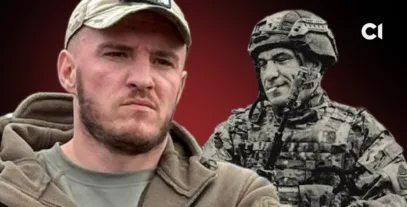
At a prisoner-of-war camp in western Ukraine, Slidstvo.Info met Zuhraddin Yuldoshev, an Uzbek national whom the Russians forced to sign a contract through blackmail: either eight years in prison or the front lines. Such stories are not exceptions. In Russia, security forces conduct mass arrests of undocumented migrants from Central Asia during raids, threatening them with criminal cases and sending them to fight against Ukraine. Other migrants go to war in exchange for a Russian passport and promises of millions of rubles for their service.
Migrants from Central Asia, as well as from Sri Lanka and Nepal, currently constitute the largest group of foreigners in the prisoner-of-war camps. Although Russia actively recruits them into its army, it is in no hurry to return them from captivity.
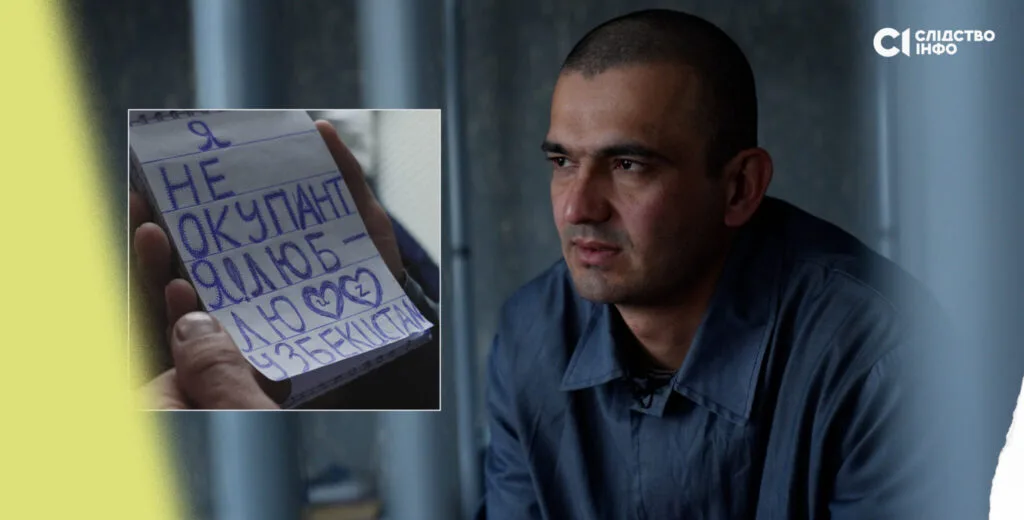
“I AM NOT AN OCCUPIER; I LOVE UZBEKISTAN”
“Here it says: ‘We are against the war.’ ‘Set me free.’ And this: ‘Bored without family.’ ‘I am not an occupier; I love Uzbekistan,'” says Zuhraddin Yuldoshev, an Uzbek national, as he turns page after page of his notebook, which bears the Red Cross logo on the cover. He received the notebook here, in a prisoner-of-war camp in western Ukraine. He explains that he draws these inscriptions in Uzbek out of homesickness for his native city of Bukhara, his wife, and his four minor children.

He has been in the camp for two months. He claims that he only managed to fight in Donetsk Oblast for two days before surrendering to the Ukrainians.

“I arrived on Ukrainian territory on September 18 (2025 — ed.). And I am still waiting for a response from our embassy. I want to return to my homeland. Even if they put me in jail, whatever happens — just let me go home,” Zuhraddin says.
The story the captive Uzbek tells is as follows: at the beginning of 2025, he sought work in Russia online and tried to find a driver job. However, the “vacancy” turned out to be a cover. Instead of civilian work, the man was taken to a military unit in Orenburg. Once he realized where he had ended up, he fled. After this, Zuhraddin again found work online, this time in Kazan, working with drywall. When he attempted to obtain work permits, he was told he was on a wanted list and faced 18 years in prison.
“And I had no other choice. I called the embassy then, but no one picked up—it just went ‘beep-beep-beep’ and then disconnected. So I signed the contract,” the captive Uzbek says.
If you’d like to see more exposés of Russian crimes on our website, please support our work with a one-time donation or a monthly contribution. You can also sign up for a monthly donation on Monobase!
In Moscow, Zuhraddin recounts, he tried to escape a second time to reach the embassy. He did not succeed. He was loaded onto a bus, taken via a roundabout route, and ultimately delivered to Rostov, from where he was immediately deployed to Donetsk Oblast.
“F*GGOT AND ‘CHURKA’ — RUN, RUN”
Zuhraddin was given no specific mission on the front lines. His role came down to simply following the Russian soldier he was paired with.
“What did this Russian say to you? Where were you supposed to go and what were you supposed to do?”
“We had orders to walk from one point to another.”
“How did the Russian treat you?”
“Badly. I almost even shot him because he called me a f*ggot and a ‘churka’ (gook–ed.) Well, like ‘black’… basically, he was cursing quite a bit. He kept giving me the wrong directions.”
At the front, Zuhraddin quickly understood the role the Russian army assigns to foreigners. He says he was not perceived as a soldier but rather as expendable material to be thrown forward to check the positions of Ukrainian defenders. He describes how he was used during his first and final outing: “I was used there as a… ‘map opener.‘ They did not know in advance what was waiting there. I was sent—thank God I was sent, because from there I just kept running. I followed a drone; my phone was not working, so I followed a Russian drone. I was attacked by five Ukrainian drones. And the commander told me: ‘Run, run.’ And I said: ‘I cannot run.’ The Russian drone turned around and flew back. It just left me. Then a Ukrainian drone ‘blinked.'”

That is how the Uzbek ended up in Ukrainian captivity. Through videos on social media, his brother, Muhriddin, learned about Zuhraddin and is now trying to bring him home. He fears that in Russia, his brother faces death for surrendering and making public statements against the country.
“We want the Ukrainian side not to hand him over to Russia. I think our country will manage to bring him back. We have done everything we could. We have already submitted written appeals to the UN, the Red Cross, and the Ministry of Justice of Ukraine; I also consulted with a Ukrainian lawyer. If Zuhraddin is sent to Russia, they will simply ‘zero him out’, and that will be it. For this, he already faces 10 to 15 years in prison in Russia if he is returned. And from there, as I am told, he will be sent back to the war in a week. It will simply be the end of him if he returns to Russia. He will be no more,” says the prisoner’s brother, Muhriddin Yuldoshev.

PRISON OR PARTICIPATION IN THE WAR AGAINST UKRAINE
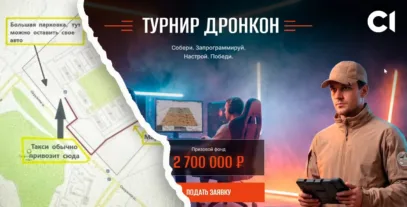
In Russia, security forces conduct nighttime raids on hostels and dormitories, detaining migrants en masse. First, they are threatened with prison; then, they are offered the chance to go to war with promises of high payments and fast-tracked Russian passports.
“For signing the contract, I was supposed to receive 3,100,000 rubles ($37,395 — ed.) within a month. But I do not even know if they entered my details. I can read Russian, but I do not understand anything. Even if that money had reached me, I would have given it to the commander just to return to Uzbekistan to my family,” says prisoner of war Zuhraddin.
Despite Moscow actively recruiting new mercenaries, it is in no hurry to retrieve foreigners from captivity or search for the missing. According to data from the “I Want to Live” project under Ukraine’s Defense Intelligence, in response to a request from Slidstvo.Info journalists, more than 18,000 foreigners are fighting on the side of Russia—and those are only the ones who have been identified. The largest numbers of citizens are from Uzbekistan, Tajikistan, and Sri Lanka.
At the prisoner-of-war camp, Slidstvo.Info journalists met a Sri Lankan man, but he could not explain why he ended up in the Russian army because he understands neither Russian nor English. A 20-year-old Tajik said he only knows about some “conflict” and does not understand the essence of the war.

According to the laws of Uzbekistan and Tajikistan, mercenariness in the army of another country is punishable by a term of 10 to 20 years. Journalists from Slidstvo.Info reached out to the embassies of these states in Ukraine for comment. After a month of waiting, the journalists still have not received an answer as to whether their governments are prepared to return their citizens from captivity. Conversely, the Ukrainian side is open to negotiations, says Petro Yatsenko, a representative of the Coordination Headquarters for the Treatment of Prisoners of War: “We are ready to negotiate on how and under what conditions they will be returned. Some governments have shown interest and there have been some successful cases, but we are, of course, waiting for broader interest, and this will then be implemented one way or another. It must be understood that prisoners of war are held at the expense of our taxpayers, even though they do work.”
Prisoner of war Zuhraddin is ready to return only to his homeland, as he is convinced that execution awaits him in Russia.
“This is not our war. In general, the war just needs to be stopped, and that is it. I would tell Uzbeks, Tajiks, Kyrgyz, and Kazakhs: if the Russians say they will put you in prison, it is better to go there,” Zukhraddin says.